If you don’t know very much about sealless pumps, allow me to shed a little light on why and how these zero emission pumping technologies exist.
1. Sealless pumps have been around for a very long time.While it is hard to pinpoint exactly when magnetic drive pumps were invented, the technology has existed since the early 1900’s; though the type of magnets originally used were of poor quality, meaning they had to be very large in order to transmit the required torque. Sometimes, instead of two magnets, one was used against a magnetic mass (a piece of iron, for example). This original arrangement required very large motors and was not really economically feasible. Later in the 1970’s, with the use of rare earth magnets such as samarium cobalt, the magnets were much smaller and more efficient, leading to the units being more economically feasible.
2. Mechanical seals always leak. To explain it simply, mechanical seals have 2 parts. One part is bolted to the housing (stationery), and the other part is attached to the shaft (rotates with the shaft). The two parts of the mechanical seal are what keeps the fluid from leaking out; but because one part is moving, and one part is not, the mechanical seal eventually wears out and leaks. Wear and the resulting leaks are inevitable – making sealless pumps critical in many hazardous applications.
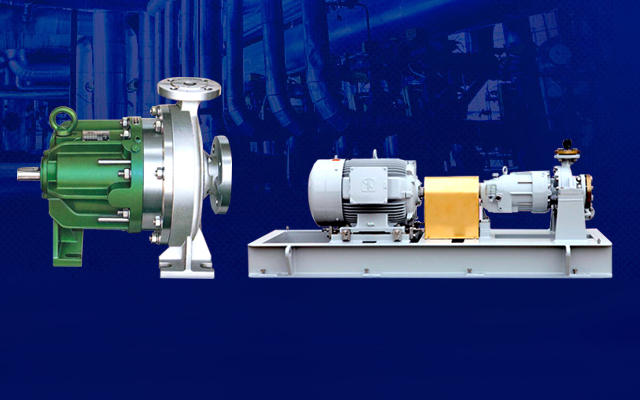
3. Mag drive pumps are ‘zero emissions’ pumps. Mag drive pumps (short for magnetic drive) do not require mechanicals seals because they rely on a containment shell to form a liquid pressure boundary. In a mag drive pump, the shaft from the motor is connected to an outer magnet carrier. Attached to the other part of the pump is a containment shroud, and inside of that containment vessel is another shaft – which is not same as the shaft connected to the motor. This shaft inside the containment shell is connected to the impeller, and inside the shroud is another magnet. So the outer magnet in the carrier is connected to the motor, and when it spins, the magnetic forces go through the containment vessel to the inner magnet (which is attached to shaft which is attached to impeller) to rotate the shaft.
4. Sealless Pumps keep people and the environment safe. Sealless pumps typically transport hazardous materials that may sometimes be considered ‘environmental contaminants’, making zero-leakage sealless pumps critical for employee and environmental safety. While petrochemical plants and refineries in the U.S. have been slow to adopt canned motor pumps and mag drive pumps, the establishment of API standard 685 has provided the assurances needed to motivate many to install these types of pumps into their zero emissions applications.
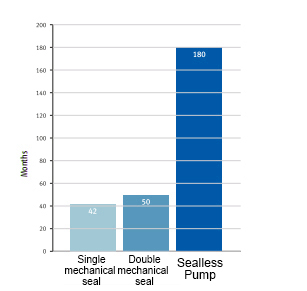 5. Sealless Pumps often surprise owners by showing extended MTBR (mean-time-between-repair). People typically choose sealless pumps for their applications, and eventually see that their MTBR frequency and maintenance costs improve (see figure 1). Typically, the mechanical seals in a centrifugal pump only last about a year and a half. Sealless pumps, on the other hand, can operate 2 to 3 years without maintenance (unless bearings need to be replaced). If MTBR is increased, the total life cycle cost of the pump ends up being much more cost effective.
If you want to learn more about Sealless pumps, contact me or visit www.dickow.com.