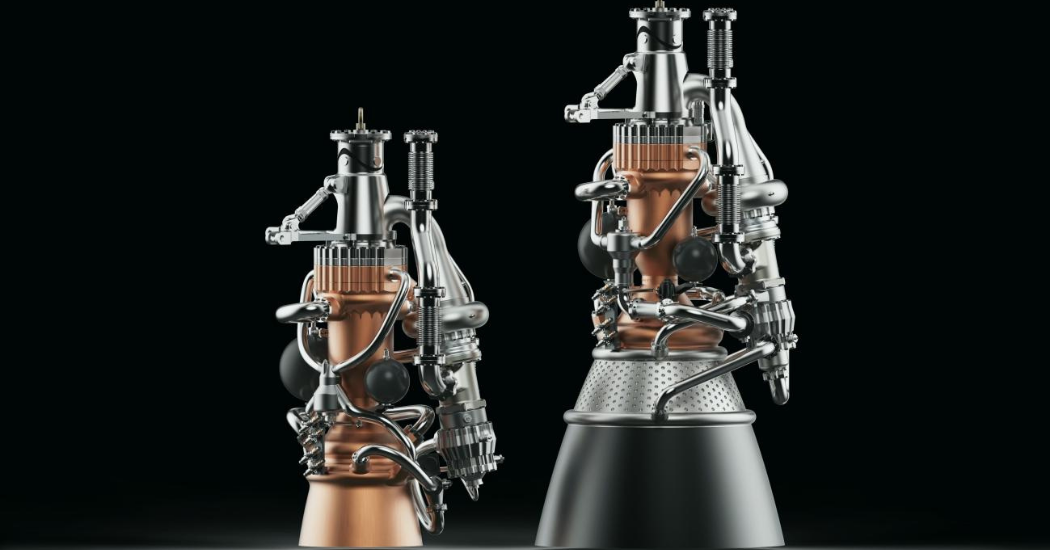
Today, rockets are used to transport satellites and humans into space. These rockets use a cluster of liquid-propellant engines to generate thrust in the lower stage – in some heavy-duty designs with solid-fuel boosters – and in the upper stage often a single liquid-propellant engine of the same type with a thrust nozzle adapted to the vacuum. The enormous thrust generated by a liquid rocket engine is created by the combustion of high mass flows of fuel and oxidizer in the combustion chamber and the subsequent expansion of the combustion gases in the thrust nozzle. In modern liquid rocket engines, the pressure in the combustion chamber reaches up to 30 MPa, with temperatures rising to an extreme 3,000°C. Fuel and oxidizer are stored in liquid state in thin-walled, cylindrical tanks pressurized to approximately 0.5 MPa. The liquid oxygen is cryogenic at -193°C, but even fuels that are liquid at normal ambient temperature are cooled down for maximum density. The two liquids are fed and their pressure increased to a level above the combustion chamber pressure by means of turbopumps.