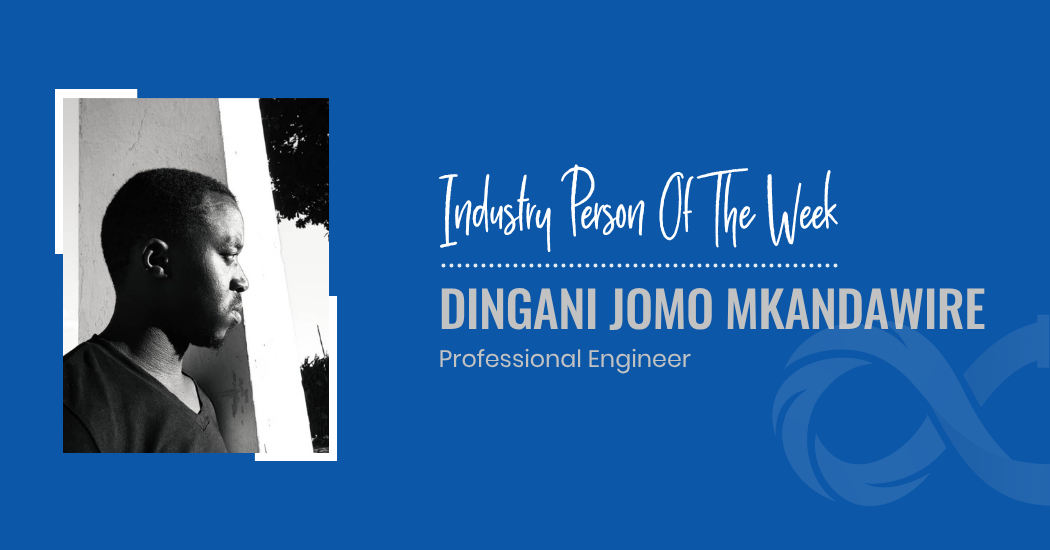
Meet our Industry Person of the Week Dingani Jomo Mkandawire, a registered Professional Engineer (PE) with the Malawi Engineering Institution.
Q: How did you get started working in your field?
Dingani: I got started in my field through a strong academic foundation in engineering and geospatial science, combined with a passion for solving water and agricultural challenges in Malawi. Early in my career, I worked in the private sector with organizations such as FISD and Yethu Group, where I gained hands-on experience in the design and construction of irrigation and water supply systems. This practical exposure gave me a deep understanding of how infrastructure performs in real-world conditions, and it sparked my interest in developing more efficient and sustainable solutions. I later pursued an MSc in GIS, which allowed me to integrate spatial analysis into engineering practice and improve decision-making in irrigation planning and water resource management. Over time, I transitioned into more strategic roles, managing donor-funded projects and contributing to national irrigation initiatives, which led to my current role as Principal Irrigation Engineer in the Ministry of Agriculture. Alongside my government work, I also expanded into consultancy through BASEflow Services, where I focus on innovative WASH solutions such as solar-powered water systems, flood-resilient infrastructure, and sanitation technologies like biogas production from waste. This combination of public sector leadership and hands-on innovation has shaped my journey in the field.
Q: What do you love the most about your job? What are you most proud of?
Dingani: What I love most about my job is the ability to make a real difference in people’s lives through engineering. Working in irrigation and water systems means the solutions we design directly impact food security, livelihoods, and community well-being.
I enjoy working at the intersection of engineering and innovation—using GIS, data, and field experience to solve complex challenges. Whether at national or community level, it’s fulfilling to know the work contributes to long-term resilience and sustainability.
The diversity of my role, from technical design to stakeholder engagement, keeps me constantly learning and motivated.
I am most proud of contributing to sustainable water and irrigation solutions that create impact at both community and national levels. A key highlight is my work with BASEflow Services, where we developed a practical manual guiding stakeholders on the design and construction of floodproof handpump systems—helping ensure reliable water access in flood-prone areas. I am also currently contributing in developing a manual on Managed Aquifer Recharge (MAR) to support climate-resilient groundwater management.
Additionally, I’ve contributed to innovative WASH projects, including solar-powered water systems and a sanitation initiative at Kapeni Primary School that uses a bio-reactor to produce biogas from waste. Overall, I take pride in bridging engineering with innovation to deliver solutions that not only provide infrastructure, but also build resilience and long-term sustainability.
Q: What advice would you give to someone considering this line of work or new to the field?
Dingani: I would advise anyone entering this field to build a strong technical foundation, but equally prioritize gaining practical, hands-on experience. Understanding how systems work in real-world conditions is essential, especially in water and irrigation engineering where local context greatly influences design and performance. Be open to learning and embracing new tools, particularly GIS, remote sensing, and data-driven approaches, as these are becoming increasingly important in improving efficiency and decision-making.
I would also encourage young professionals to stay curious and solutions-oriented. The challenges in this field, such as climate variability, resource constraints, and infrastructure limitations, require creativity, adaptability, and a willingness to think beyond conventional approaches.
Finally, always remember the bigger picture. This work is ultimately about improving lives, so engaging with communities and understanding their needs is just as important as the technical design itself.
Q: Can you talk about a project you recently worked on?
Dingani: One recent project I worked on with BASEflow involved a school sanitation initiative at a primary school in Blantyre, Malawi. The project was implemented in collaboration with a local partner and funded through Toilets 4 All, with the aim of improving both sanitation and water access in a more integrated and sustainable way.
We designed and delivered a combined WASH solution that went beyond conventional sanitation upgrades. On the sanitation side, we transitioned the school from basic pit latrines to improved flushing toilets connected to a bio-reactor system. This reactor treats toilet effluent while also generating biogas, which can be used as a clean cooking energy source. The idea was to create a circular system where waste is not just disposed of, but converted into a usable resource.
In parallel, we developed a reliable solar-powered water supply system to ensure consistent access to safe water for the school. This was critical for supporting both the new sanitation facilities and the daily needs of students and staff, while also ensuring long-term operational sustainability with minimal running costs.
What made the project particularly impactful was its integrated and innovative design approach. Instead of treating water supply, sanitation, and energy as separate challenges, we addressed them as interconnected systems. This allowed us to improve hygiene conditions, enhance energy access, and strengthen the overall resilience of the school environment in one coordinated intervention.
The project is also significant because it is one of the first of its kind in our context. We are currently monitoring its performance closely, identifying operational gaps, and refining the design for future replication. I see this as a strong example of the kind of work I am passionate about—developing practical, resource-efficient solutions that are sustainable and adaptable to local conditions, while delivering real impact on the ground.
Q: Anything else you would like to add?
Dingani: I would simply add that I am grateful for the opportunities I have had to contribute to water and irrigation development in Malawi, both in the public sector and through consultancy work with BASEflow Services. Being able to work across different scales—from national irrigation planning to community-based WASH innovations—has given me a deeper appreciation of how interconnected engineering, sustainability, and community development truly are.
I am particularly encouraged by the growing role of innovation and collaboration in our sector. The integration of GIS, climate-resilient approaches such as Managed Aquifer Recharge, and practical design tools like our (BASEflow) floodproof handpump manual all point toward a future where water solutions are more adaptive, inclusive, and sustainable.
Moving forward, I remain committed to contributing to this evolution; developing practical solutions that not only address today’s challenges but also build resilience for future generations.
Connect with Dingani Jomo Mkandawire on LinkedIn: https://www.linkedin.com/in/dingani-mkandawire-2b4304b3
THANK YOU, DINGANI JOMO MKANDAWIRE! WE LOOK FORWARD TO KEEPING UP WITH YOU THROUGH THE #PUMPTALK COMMUNITY!