If you’re running pumps or mixers in abrasive slurry service and replacing seals every few weeks—or even months—you’ve probably heard the standard explanation:
“Abrasive slurries cause wear.”
That’s not wrong. But it’s not useful either.
Because until you understand how that wear actually occurs at the interface level, you’re not solving the problem—you’re just cycling through parts.
The Real Problem: Abrasion Is a Mechanism, Not Just a Condition
In slurry applications—mining, pulp stock, wastewater solids, chemical processing—the challenge isn’t just the presence of solids.
It’s how those solids behave under pressure, velocity, and confinement inside the sealing interface.
Mechanical seals are designed to operate with a micron-thin fluid film between two faces. Under ideal conditions, that film:
- Separates the faces to prevent direct contact
- Removes heat generated by friction
- Maintains a stable coefficient of friction
- Preserves surface finish
But slurry service disrupts that equilibrium almost immediately.
 What’s Actually Happening at the Seal Face Interface
Let’s break down the real failure mechanism.
1. Particle Ingress
Even with proper installation, slurry particles migrate into the seal interface due to:
- Pressure differentials
- Turbulence at the seal chamber
- Inadequate flush velocity or direction
In many slurry systems, maintaining a consistent flush is inherently difficult. Flush plans are often sensitive to pressure fluctuations, plugging, or flow interruptions.
>> It only takes a brief disruption—a pressure drop, a partially clogged line, or a momentary loss of flow—for abrasive particles to reach the seal faces.
Once that happens, the faces are immediately exposed, and the wear process begins.
Once inside, particles don’t behave like fluid—they behave like cutting media.
2. Particle Embedding (The Critical Turning Point)
This is where failure truly begins.
- Softer seal materials (typically carbon) trap abrasive particles
- Embedded particles become fixed cutting points
- The seal face transforms into a lapping tool
Instead of two smooth surfaces sliding across a lubricated film, you now have:
>> A rotating abrasive disk acting on a stationary surface
3. Three-Body Abrasion
At this stage, the system enters what’s known as three-body abrasion:
- Seal face (surface 1)
- Opposing face or sleeve (surface 2)
- Abrasive particles (third body)
This dramatically accelerates wear because:
- Particles continuously roll, slide, and cut
- Surface roughness increases
- Heat generation rises
- Lubrication breaks down further
4. Surface Degradation and Leakage Formation
As wear progresses:
- Seal faces lose flatness (critical for sealing)
- Micro-grooves form, creating leakage paths
- Shaft sleeves develop circumferential scoring
- Face loading becomes uneven
>> At this point, leakage is no longer preventable—it’s inevitable.
What Wear Looks Like in the Field
When you inspect failed seals from abrasive slurry service, the patterns are consistent:
- Radial scoring across seal faces
- Circumferential sleeve grooving from embedded particles
- Polished or glazed carbon faces indicating overheating
- Micro-chipping or edge fracture in hard faces (SiC, tungsten carbide)
- Visible particulate embedded in softer materials
These are not isolated defects—they are signatures of a predictable failure mechanism.
The Hidden Multiplier: Shaft Movement and Instability
Abrasive wear alone is damaging—but when combined with mechanical instability, failure accelerates.
And in reality, many—though not all—of these applications are operating in less-than-ideal mechanical conditions.
It’s common to see:
- Misalignment
- Vibration (especially when handling difficult or inconsistent products)
- Soft foot conditions
- Shaft runout and deflection under load
These issues introduce:
- Uneven face loading
- Intermittent contact conditions
- Disruption of the fluid film
- Increased opportunity for particle ingress
>> Even a well-designed sealing system struggles when the equipment itself isn’t mechanically stable.
The result is a compounding failure cycle:
>> abrasion + instability = accelerated degradation
The Wrong Assumption Engineers Make
- Most responses focus on upgrading materials:
- Moving from carbon to harder composites
- Switching to silicon carbide vs silicon carbide
- Increasing seal robustness
The assumption:
>> “Stronger materials will resist wear.”
But in reality:
>> You’re still exposing those materials to the same failure mechanism.
Harder materials may resist embedding—but they:
- Increase brittleness
- Become more susceptible to fracture
- Still experience abrasion under particle loading
You’re not solving the problem—you’re extending the timeline.
Why Traditional Sealing Solutions Struggle
Mechanical Seals
- Require stable lubrication to function
- Lose effectiveness when fluid film collapses
- Generate heat under abrasive conditions
- Are highly sensitive to alignment and vibration
Compression Packing
- Allows controlled leakage, but still suffers abrasion
- Packing fibers trap particles, accelerating sleeve wear
- Requires frequent adjustment to maintain performance
- Creates ongoing maintenance burden
In both cases, the limitation is the same:
>> They rely on surface contact in an environment that destroys surfaces.
What Actually Works: Eliminating the Failure Mechanism
To solve abrasive slurry sealing challenges, you have to stop thinking in terms of resistance—and start thinking in terms of elimination.
>> Remove the contact, and you remove the failure.
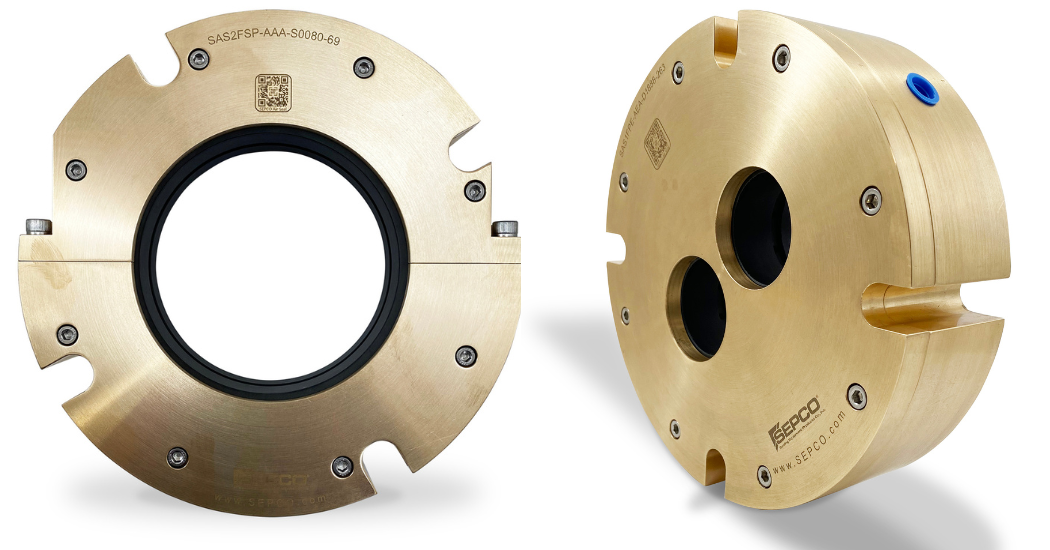
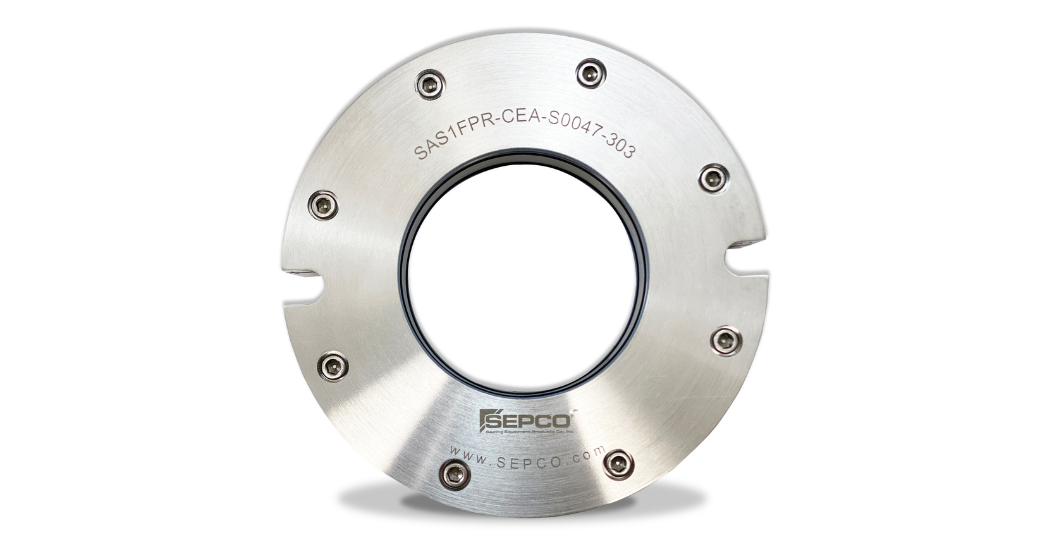
Non-Contact Sealing: The SEPCO SAS Air Seal
The SEPCO SAS Air Seal is designed specifically to eliminate the interaction that causes abrasive failure.
How It Works (Engineering Perspective)
- Air is supplied at 5–10 PSI above process pressure
- Internal geometry creates a controlled pressure gradient and velocity profile
- This generates a stable circumferential air barrier
The barrier prevents:
- Particle ingress
- Product leakage
- External contamination
Why It Works
- No contact = no abrasion
- No particle embedding
- No lapping mechanism
- No reliance on lubrication
- No heat generation from friction
- Tolerates shaft movement and misalignment
>> It doesn’t fight the application—it removes the failure condition entirely.
The Bottom Line
If your seals are failing in abrasive slurry service, it’s not random—it’s physics.
And until you address:
- How particles reach the seal faces
- How they interact with materials
- How equipment instability amplifies the problem
…failure will continue.
>> Because the problem isn’t the seal—it’s what’s happening inside it.