Contributor: Watson-Marlow Fluid Technology Group
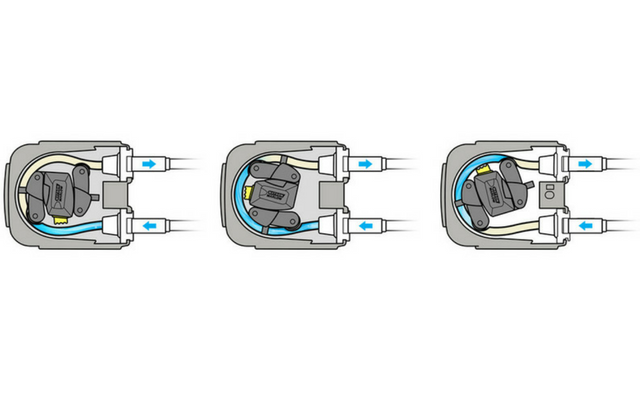
The diagram above shows how rollers or shoes in a peristaltic pump compress the tube or hose as they rotate, creating a vacuum which draws fluid through the tube.
Nothing but the pump tube or hose touches the fluid, eliminating the risk of the pump contaminating the fluid, or the fluid contaminating the pump. The animation can be viewed on the Watson-Marlow Fluid Technology Group website showing fluid being drawn into a pump tube, trapped by the pumphead roller, and expelled when the next roller passes over the tube. As the rollers rotate, a vacuum is formed in the tube, pulling in more fluid, for the next roller pass.
The complete closure of the tube when is it occluded (squeezed) between the roller and the track, gives the pump its positive displacement action, preventing backflow and eliminating the need for check-valves when the pump is not running.
Why should you choose a Watson-Marlow industrial peristaltic pump?
- Easy to install, simple to operate and inexpensive to maintain
- Low shear, gentle handling without impellors, vanes, lobes or valves in the fluid path
- No ancillaries needed for installation or running
- Scalable technology to meet varying process needs
- LoadSure tube elements provide one minute maintenance, easy installation and increased productivity
- Superior flow stability and metering accuracy
- The only replacement part is the low cost hose or tube which can quickly be replaced in-situ
Watson-Marlow work closely with their customers to demonstrate how pumps ensure accurate metering, transfer and filling, to deliver significant process efficiencies with extremely low maintenance and low whole life cost.