The trenchless pipe market in the U.S. and Canada is projected to grow from US$8.8 billion in 2026 to US$14.2 billion annually by 2035 as water and wastewater utilities prioritize infrastructure renewal.
At the current pace of municipal pipe rehabilitation and replacement, renewing the region’s 4.6 million miles of underground water and wastewater pipes will take more than a century. As utilities face aging infrastructure and mounting financial pressures, trenchless technologies are emerging as one of the fastest-growing segments of the market.
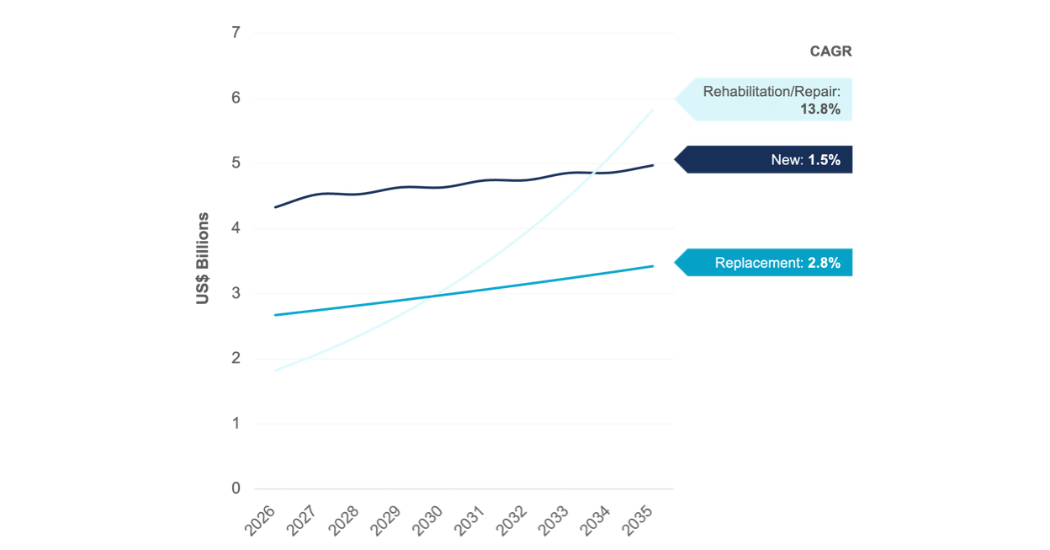
Bluefield Research’s new report, U.S. & Canada Water & Wastewater Trenchless Pipe Market: Drivers, Trends, and Forecasts, 2026–2035, forecasts municipal utility spending to exceed US$111.9 billion over the next decade. While overall annual spending is expected to increase at a compound annual growth rate (CAGR) of 5.4%, rehabilitation-focused activities are projected to grow at a CAGR of 13.8%, significantly outpacing the broader market, which includes new construction, replacement, and rehabilitation/repair.
“Utilities can’t dig their way out of a century-long renewal backlog,” says Megan Bondar, an analyst at Bluefield Research. “The cost and disruption created by tearing up streets with traditional excavation methods is moving trenchless options further up the list of asset management strategies.”
Exhibit: Annual Trenchless Spending by Project Type, 2026–2035
 Source: Trenchless Technology, Statistics Canada, Bluefield Research
Wastewater Infrastructure Leads Trenchless Market Growth
Wastewater networks account for 54% of trenchless spending, with annual growth of 6.6% compared with 4.1% for drinking water applications. Additionally, more than 89% of projects awarded through State Revolving Funds (SRFs)—a primary channel for federal water and wastewater infrastructure funding—have focused on wastewater applications since 2020.
“Wastewater remains the more established market for trenchless applications, supported by a longer track record of deployment and fewer barriers to implementation. Drinking water presents a longer-term growth opportunity, but wider adoption will depend on addressing more demanding structural and regulatory requirements,” Bondar notes.
Cured-in-Place Pipe (CIPP) Dominates Pipeline Rehabilitation
Among the three pipe rehabilitation technologies forecast by Bluefield Research, cured-in-place pipe (CIPP) accounts for 81% of projected spending, representing US$28.3 billion through 2035. Sliplining and spray-in-place pipe (SIPP) account for the remaining 19%.
This growth presents significant opportunities for suppliers of liners, resins, and curing equipment over the next decade. CIPP’s market leadership is supported by a proven track record dating back to the 1970s. Nearly four out of every five dollars that the 20 largest trenchless spenders plan to invest are allocated to CIPP.
Ultraviolet (UV) light-cured liners are also an emerging area of opportunity. A decade ago, high equipment costs and limited technical expertise restricted UV CIPP adoption. Today, the technology competes alongside conventional heat-cured systems, with western states emerging as a growth market. Because UV systems often use styrene-free resins, they could also create new opportunities for drinking water main rehabilitation.
“With federal funding from the American Rescue Plan Act (ARPA) and the Infrastructure Investment and Jobs Act (IIJA) winding down, utilities need to squeeze more out of every dollar, which plays to the strengths of CIPP and other trenchless technologies. Vendors tout the ability to renew pipes at a fraction of the cost,” says Bondar.
Urban Infrastructure Drives Demand for Trenchless Technologies
Large cities account for 58% of installed pipe infrastructure and 76% of forecasted trenchless spending. The costs associated with street closures, excavation, and repaving, combined with the speed of trenchless installation and rehabilitation, make these technologies an attractive option for urban infrastructure projects.
In the U.S., Texas, California, and Florida stand out in projected trenchless spending. Texas alone accounts for US$15.2 billion of the forecast, driven by extensive pipe networks and rapid population growth.
Regional investment priorities also vary across the country. In the Northeast and Midwest, which contain some of the nation’s oldest pipelines, infrastructure renewal accounts for more than 70% of trenchless spending. Meanwhile, the South and West place greater emphasis on new construction.
Canada also favors new construction and represents the faster-growing market, with annual growth of 6.1% compared with 5.4% in the U.S. Ontario and Quebec lead Canadian pipeline rehabilitation investment, while Alberta leads greenfield development.
“Canada offers a glimpse of where this market can go. Canadian utilities already use trenchless at higher rates than their counterparts south of the border, including CIPP on potable water mains, which is still the exception in most of the United States,” says Bondar.
About Bluefield Research
Bluefield Research provides data, analysis, and insights on global water markets, covering the municipal and industrial sectors across infrastructure, policy, and technology. As a leading provider of water market intelligence, Bluefield helps strategic decision-makers understand where the water market is going—and why.
The Insight Report, U.S. & Canada Water & Wastewater Trenchless Pipe Market: Drivers, Trends, and Forecasts, 2026–2035, presents a comprehensive analysis of the U.S. and Canada trenchless pipe market. It provides a data-driven perspective on how market drivers, forecasts, and regional dynamics are reshaping the landscape for investments in trenchless pipe projects. The full report is available for purchase and immediate download on Bluefield’s website.
Originally published by Bluefield Research. Read the original article to learn more about trenchless pipe market growth and investment trends in water and wastewater infrastructure.