Variable Frequency Drives (VFDs) play a critical role in improving industrial energy efficiency and reducing energy consumption. However, achieving maximum VFD efficiency requires more than installation alone—it also depends on monitoring motor performance and optimizing actual power usage. To truly improve VFD performance, operators need to monitor the real work output of the motor, not just current or amperage.
Real work, measured as true motor power, accounts for the shifting voltage and power factor inherent in VFD-controlled systems. By measuring actual mechanical workload, facilities can pinpoint exactly where energy is wasted, identify the best efficiency point on a pump or fan curve, and confirm the drive isn’t overcompensating for underlying mechanical issues.
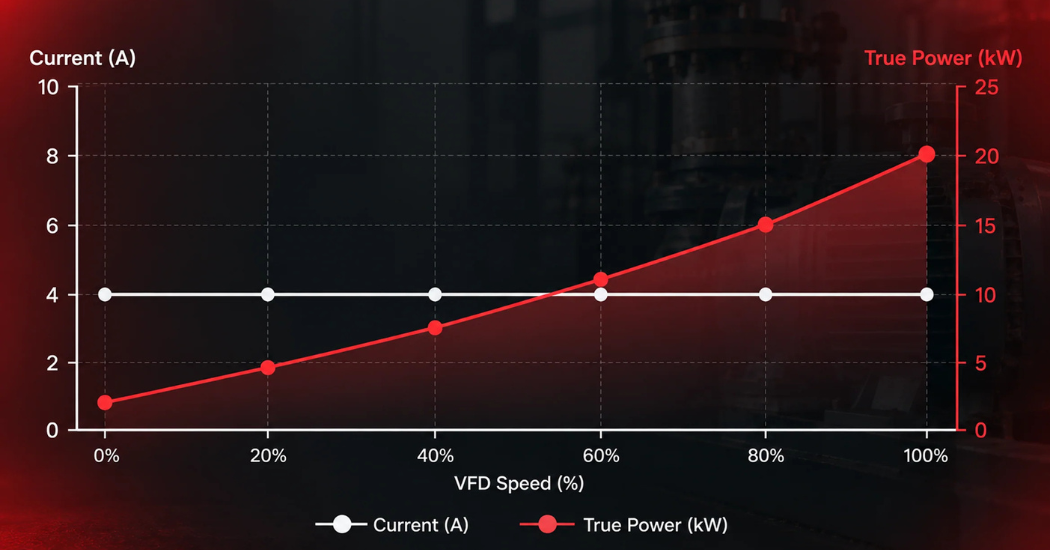 Why Is Amperage an Unreliable Measure of VFD Efficiency?
Side-by-side comparison graphic of an amperage meter vs. a true power sensor readout
Measuring amps in a VFD system can be misleading, current often stays high even when actual work performed is low. True power sensors solve this by providing a linear metric reflecting the real energy consumed to move the load.
- Finding the Best Efficiency Point: Every pump and fan has a specific speed where it runs most efficiently. Power monitoring supplies the data needed to find this sweet spot, so the VFD can be programmed for maximum energy savings.
- Accounting for Power Factor Changes: As VFDs reduce motor speed, power factor often degrades. True power sensors factor this into their calculations for a more accurate picture of electrical efficiency.
- Why Motor Power Is a More Sensitive Metric: Motor power is up to ten times more sensitive than current alone, making it far easier to detect subtle efficiency losses from internal wear, friction, or process changes.
Which Sensors Are Best for VFD Energy Optimization?
Load Controls provides specialized sensors and digital units built to deliver high-resolution data in the challenging electrical environments created by VFDs.
- Universal Power Cell (UPC): The premier sensor for VFD applications. It uses balanced Hall Effect semiconductors to calculate true power and delivers a linear analog output ideal for continuous energy monitoring at any speed.
- PMP-25V Load Control: A digital unit that pairs with a power cell to display motor load as a percentage, horsepower, or kilowatts giving operators real-time visibility into actual work performed.
- TP-2 Compact Motor Power Sensor: Built for space-constrained motor starter enclosures, this loop-powered sensor integrates with a PLC to track real work output across multiple VFD-driven motors.
- ROC-50 Rate of Change Control: Detects rapid load shifts, making it essential for catching sudden efficiency drops caused by clogs or mechanical obstructions.
Where Does Real Work Monitoring Deliver the Biggest Impact?
Integrating real work monitoring with VFD-controlled motors provides the intelligence needed to sustain high efficiency across industrial sectors:
- Pumping System Optimization: In wastewater and chemical processing, power monitoring flags when a pump deviates from its optimal curve, allowing speed adjustments that save energy and prevent cavitation.
- HVAC and Fan Control: Large air handling units rely on VFDs to manage flow. Monitoring real work ensures fans aren’t working harder than necessary to overcome dirty filters or blocked ducts.
Conveyor and Material Handling: Power sensors track conveyor motor load, ensuring VFDs draw only the power required for the material’s actual weight. - Predictive Maintenance Awareness: A vertical shift in power needed to perform the same work is an early warning sign of mechanical degradation, such as bearing wear or misalignment.
VFD-driven pump and fan systems in an industrial facility
What Financial Returns Can Facilities Expect from Power Monitoring?
Monitoring real work output provides the metrics needed to justify energy-saving initiatives and reduce total cost of ownership:
- Verifying Utility Energy Savings: Facilities can track power data in kilowatt-hours over time to verify actual VFD savings and report findings to stakeholders.
- Identifying Oversized Equipment: Captured load data often reveals motors that are larger than necessary, highlighting right-sizing opportunities.
- Utility Rebate Access: Many energy providers offer rebates for installing VFDs alongside the advanced motor controls that optimize their performance.
- Calculating Carbon Footprint: Integrating power data with environmental reporting tools allows facilities to accurately calculate emissions tied to VFD-driven processes.
About Load Controls and Industrial Control Solutions
Load Controls, part of Industrial Control Solutions, specializes in the manufacture of load controls, pump controls, universal power sensors, and other sensors. The company prides itself on the diversity and quality of its product offering and the industry leadership position its brands have held for over 40 years.
As a Service-Disabled Veteran-Owned Small Business, Industrial Control Solutions believes in applying the same principles of military service to its everyday practices: tireless dedication, rigorous standards of quality, and faithfulness to its values and mission. This translates into providing a high-quality product to exact specifications that always exceeds performance expectations.
Industrial Control Solutions is built on its extensive offering of high-quality, customized switches, sensors, and thermocouples, custom-built and shipped to exact specifications based on application, media environment, and other performance requirements.
Industrial Control Solutions is fiercely committed to its clients, particularly those who have been loyal partners throughout its 40+ years of operation, staying true to the core values the brand was built on: high-quality products with a focus on customer service.
Load Controls is ISO 9001:2015 certified, giving customers confidence that internal processes and products are held to the highest standards of quality and rigorous testing.
Load Controls product portfolio spans specialized USA-manufactured lines:
Whitman Controls – Pressure switches, vacuum switches, differential pressure switches, temperature switches, continuous level transmitters, and more.
Thomas Products – Flow switches, level switches, pump controls, multi-level switches, visual indicators, and related accessories.
Duro-Sense – Platinum and Noble thermocouples, RTDs, and ISO 17025-calibrated wire sales.
Frequently Asked Questions
Why isn’t amperage a reliable measure of VFD efficiency?
Amperage can remain high even when a motor is doing very little actual work, since VFDs cause current and power factor to shift with speed. True power sensors measure real mechanical output, giving a far more accurate efficiency picture.
What is the best efficiency point on a pump or fan curve?
It’s the specific speed at which a pump or fan performs its required work using the least energy. Power monitoring data helps operators identify this point and program the VFD accordingly.
Which sensor is best for continuous VFD power monitoring?
The Universal Power Cell (UPC) is designed specifically for this, it uses Hall Effect semiconductors to calculate true power and outputs a linear analog signal suitable for continuous monitoring at any motor speed.
How does real work monitoring support predictive maintenance?
A gradual increase in power needed to perform the same task without a change in output, signals developing mechanical issues like bearing wear or misalignment, allowing maintenance teams to act before failure.
Can VFD power monitoring help secure utility rebates?
Yes. Many utility providers offer rebates for VFD installations paired with advanced motor controls that demonstrably optimize performance and reduce wasteful energy spikes.