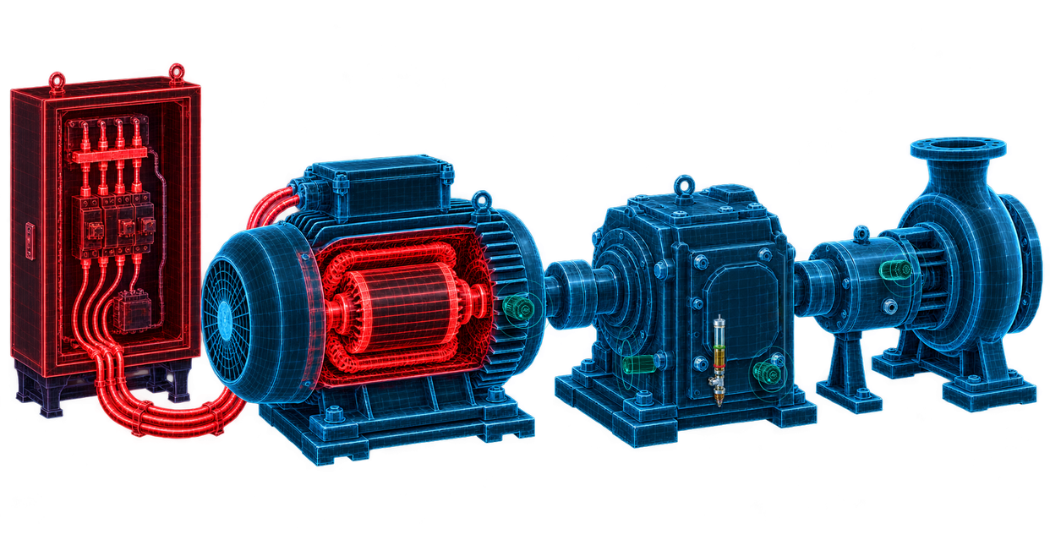
Electrical monitoring shows how hard a pump’s motor is working, and helps plants decide where to start
Start with criticality. Learn which pumps to monitor first and how motor current reveals belt, impeller, and electrical faults before failure.
At one site, three identical motors ran side by side
Three pump motors ran side by side. One failed, and the site suspected binding or overloading. The team worried the replacement would fail quickly if the cause wasn’t found, and that the other two might be next.
Dustin Moore, Condition Monitoring Engineer Manager at AssetWatch, compared the current draw across all three units and against their nameplate ratings. The comparison gave the team enough confidence to keep operating as normal.
“If one pump develops a problem, especially if you’ve got several there in a row, it becomes very apparent that something’s going on with this one,” Moore says. Continuous monitoring keeps that comparison in front of the team at all times.
Start with the pumps that can’t afford to surprise you
Most maintenance programs don’t fail because technology is bad. They fail because attention is spread too thin. Monitoring every pump the same way makes that problem worse. Plants get more value from starting with criticality: which assets would stop production if they failed, which have redundancy, and which can safely run to failure. Teams often find that if everything is critical, nothing is, so the highest tier should hold only a small share of assets.
From there, match the technology to each asset’s likely failure modes. Case history is the most practical starting point. “If you’ve had certain pumps with a history of electrical failures, that’s a candidate to add electrical monitoring to,” Moore says.
The P-F curve explains why timing matters. A fault becomes detectable at the P point, and the asset stops doing its job at the F point. The gap between them is the window to act. Early detection means more planning time, and more planning time means lower-cost repairs. Moore puts the stakes plainly: catching a fault early is the difference between a planned bearing swap and an unscheduled emergency teardown.
SMRP and AssetWatch recently covered this approach in an on-demand webinar, “Not All Assets Are Equal: Using Criticality to Build a Smarter PdM Program.”
Electrical faults can also appear before vibration shows anything. A motor can develop winding degradation, insulation breakdown, or phase imbalance well before a clear vibration signature appears. That gives the team more time to plan.
 What motor current reveals about pump health
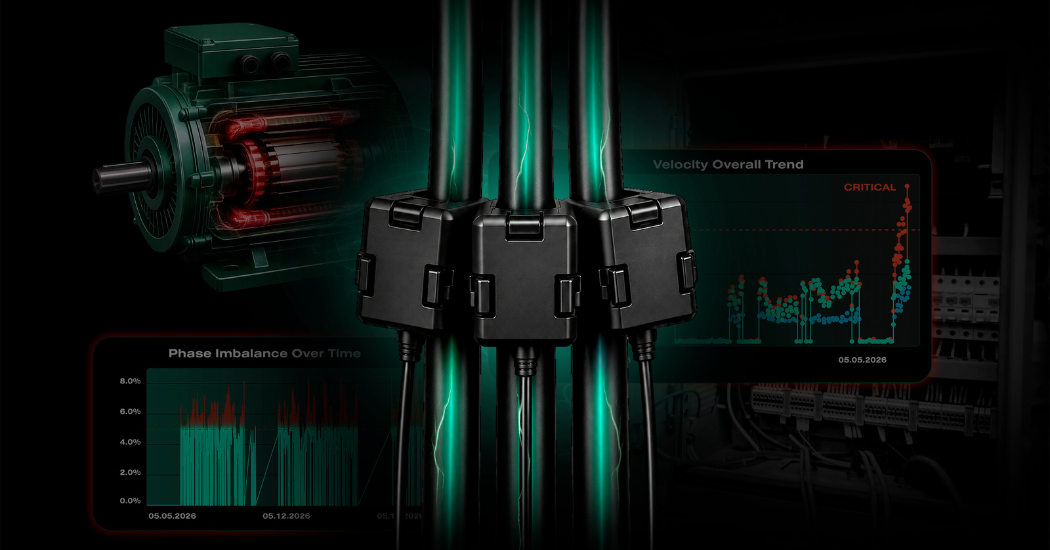
The electrical data gives a technician specific clues, and the pattern of the change matters as much as the change itself. Christopher Marek, Program Manager, Electrical Monitoring at AssetWatch, says a slipping belt shows up as intermittent drops in load, while a broken belt shows a sustained drop with the motor spinning freely.
| What the data shows | What it may point to |
|---|---|
| Intermittent drops in load (amperage) | A slipping belt |
| A sustained drop in load, with the motor spinning freely | A broken belt |
| Current unbalance across the three phases | A loose connection in the panel |
| Current rising steadily over time | Product buildup or a restriction in the process |
Current can also point to what the pump is doing. A pump drawing less current than normal can mean the motor is running without doing useful work, which may point to impeller wear, a flow restriction, or a coupling issue. Electrical and vibration data work together here: a worn bearing creates drag and drives current up, while a worn impeller reduces load and drives current down.
Moore describes a related pattern at a motor control center, where a high-resistance connection would likely show up as an imbalance between phases in the current before vibration changes.
Who needs what from the data
Each group on the plant floor needs something different. Maintenance teams need alerts they can trust, because two false alarms or one miss can cost the team its confidence in the system. Operations needs installation that doesn’t interrupt production. Leadership needs the risk put in dollars.
Examples from the field
Four customer examples on AssetWatch’s electrical monitoring page show how the data gets used. Two fit this story especially well.
Teams can compare current trends across paired or redundant motors to confirm balanced load sharing. On one printing line, five motors did the same job, but operators picked whichever motor they preferred. Current data showed a few motors carrying most of the load while others rarely ran. That gave the team a data-backed basis to rebalance the work.
At a manufacturing facility, critical fans sat underground, where vibration sensors couldn’t deliver reliable data. Monitoring at the above-ground panels gave the team continuous visibility into motors it had never been able to watch, with no motor access required.
From alert to answer
Johan Till-Broer, Product Marketing at AssetWatch, says the goal is an answer, not another alert. Anyone can flag a symptom. The value is in naming the likely cause and the next step.
 Which pumps to monitor first
Marek says tier one motors come first, since a surprise costs more there. Three other groups make good next candidates:
- Motors in hard-to-reach spots, such as submerged pumps that are difficult to inspect
- Motors with repeat problems
- Motors with no monitoring at all
Marek compares a customer’s first week to onboarding a new employee. “Week 1 is like taking a new employee on a walk through the facility before asking them to spot what’s unusual,” he says. From this, the team learns how equipment normally runs, so later it can recognize meaningful changes.
A real pump, on a real water system
The City of Tulsa’s raw sewage pump is an example of how a pump can be protected from unplanned downtime. AssetWatch’s vibration monitoring caught a problem before it became a failure, and the team was able to plan the repair.
Electrical monitoring adds one more layer on the same platform. Marek puts it this way: “Current alone does not tell you the full story. That’s why having multiple layers of monitoring can be important for critical pumps.”
Monitoring isn’t protection
A common assumption is that current monitoring can replace protective devices. Marek says it can’t. “Current monitoring can help identify abnormalities or issues, but it will not be sufficient in protecting your motor. Protective devices are designed to prevent several conditions that can be detrimental to a motor, for example single phasing.”
Electrical monitoring FAQs
Does electrical monitoring replace vibration monitoring? No. It adds a layer alongside vibration and oil analysis, and the data is reviewed together on one platform.
Does installation take the motor offline? No. The clamps mount inside the panel, with no motor modifications and no production downtime.
Does it need voltage taps or control system integration? No. The sensor is self-powered through the clamps.
Join the launch webinar
“First Look: AssetWatch Electrical Monitoring” is a launch-exclusive session on November 17 from 2 to 3 p.m. EST. Dustin Moore and Johan Till-Broer host a product overview, a live demo, and open Q&A with condition monitoring engineers. Register at https://start.assetwatch.com/electrical-webinar/.
Author and reference notes
Related reading: “Closing the Maintenance Blind Spot: AC Motor Electrical Fault Detection,” AssetWatch blog, October 13, 2026.
References: AssetWatch, “AssetWatch Adds Electrical Monitoring to Catch Hidden Motor Faults Before They Cause Downtime,” PR Newswire, October 13, 2026. “Not All Assets Are Equal: Using Criticality to Build a Smarter PdM Program,” SMRP and AssetWatch.