Eight Questions About Gasket Reliability
Reliable gasket performance depends on eight factors: temperature resistance, pressure containment, chemical compatibility, mechanical movement, environmental exposure, material selection, application requirements, and joint design.
A gasket does not function independently. Its performance depends on the interaction between the gasket material, flanges, fasteners, operating conditions, and installation practices. Evaluating these components as a complete sealing system helps improve safety, emissions control, mechanical integrity, and plant reliability.
1. How does temperature and thermal cycling affect a gasket?
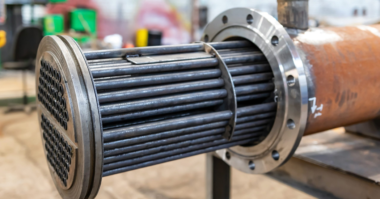
Gaskets must withstand steady operating temperatures and any thermal or pressure cycles. Temperature changes in heat exchangers, reactors, and other equipment can cause joint movement, loss of bolt preload, and reduced gasket stress.
Flexible graphite is commonly used in high-temperature service, including above 500°F, because it is heat resistant and highly compressible; allowable temperature depends on the graphite grade, service atmosphere, and whether it is oxidation inhibited. However, graphite sheet gaskets generally have limited recovery after compression. In cycling applications, semi-metallic gaskets such as spiral-wound or graphite-faced corrugated metal designs can combine graphite’s temperature resistance with a structure that provides greater strength and recovery than graphite sheet alone.
2. How does a gasket contain system pressure?
Pressure containment depends on the gasket’s ability to maintain adequate sealing stress over time. The joint must also apply and retain the required clamping load.
Spiral-wound gaskets are frequently used in high-pressure systems. They combine metal windings with a soft filler, often graphite. An outer guide ring centers the gasket, while an inner ring resists inward buckling, limits over-compression, and improves tightness and recovery.
3. Why is chemical compatibility important?
A gasket must resist the process media it contacts. Chemical incompatibility can weaken the material and compromise containment.
PTFE-based materials resist many acids, caustics, solvents, and aggressive hydrocarbons. The main PTFE options include:
- Expanded PTFE (ePTFE): Chemically resistant and conformable to irregular flange surfaces.
- Virgin skived PTFE (sPTFE): Unfilled and chemically resistant across a broad range but typically exhibits higher creep relaxation than restructured or expanded PTFE.
- Restructured PTFE (rPTFE): Filled with materials such as glass microspheres, silica, or barium sulfate to increase strength and reduce creep relaxation.
Consider chemical resistance alongside temperature, pressure, flange condition, and load requirements.
4. How do vibration and mechanical movement affect sealing?
Vibration, pipe stress, and loads transmitted from rotating equipment can change the load distribution in a gasketed joint. Gasket constructions with suitable recovery and resistance to creep and extrusion can help maintain sealing stress as joint loads change.
Even a chemically and thermally compatible gasket may fail if vibration leads to the loss of fastener preload or creates uneven loading.
5. Can storage and environmental conditions damage a gasket?
Yes. Ultraviolet exposure, weathering, aging, and thermal shock can affect gasket condition before and during service.
Elastomeric gaskets and materials containing elastomeric binders are particularly vulnerable and should generally be stored away from direct sunlight. Brittleness or cracking indicates that the gasket should not be installed.
Graphite and PTFE generally retain their mechanical properties across a wide range of ambient conditions. Nonstick surface treatments can improve removal of some rubber-bonded sheet gaskets during maintenance.
6. How should gasket materials be compared?
Material properties must match the complete operating environment:
- Virgin skived PTFE (sPTFE): Clean and chemically stable for less demanding pressure-temperature services.
- Restructured PTFE (rPTFE): Maintains the high chemical resistance and is stronger and more resistant to creep relaxation than unfilled PTFE and conventional sPTFE.
- Expanded PTFE (ePTFE): Compressible, chemically resistant, and suitable for irregular flange surfaces.
- Flexible graphite: Suitable for high temperatures, with strong compressibility and thermal conductivity.
- Metallic and semi-metallic gaskets: Spiral-wound, kammprofile, corrugated metal, and ring-type joint designs for high-pressure or high-load systems.
No single material is suitable for every application. Selection should be based on service conditions rather than one material property or initial cost.
7. Why is application-specific engineering necessary?
Each sealing application has a distinct combination of process media, temperature, pressure, equipment geometry, mechanical loads, cleanliness requirements, and regulatory obligations. Steam systems require thermal stability. Chemical applications require chemical resistance. Potable-water applications may require NSF/ANSI/CAN 61 certification. Food-contact applications may require compliance with applicable FDA regulations, and pharmaceutical or bioprocessing applications may specify USP Class VI testing or other requirements.
Specialized applications may also require custom-engineered solutions, such as PTFE gaskets for glass-lined equipment or flange-isolation gasket kits for cathodic protection.
8. How do joint design and tolerances affect performance?
Gasket selection must account for flange geometry, surface finish, fastener condition, and assembly practices. Flanges should be flat, parallel, clean, and free from damage.
Even the correct gasket can fail if the flange surfaces, fasteners, tolerances, or assembly procedures are inadequate.
Learn more about the eight design factors for optimal gasket performance: https://teadit.com/us/article/know-these-eight-design-factors-for-optimal-gasket-performance/