Southwest Research Institute (SwRI) and Southern Methodist University (SMU) are collaborating to advance solid-state battery technology. Solid-state batteries are safer, longer-lasting, and more efficient alternatives to traditional lithium-ion batteries, offering faster charging and greater energy storage potential. They are especially promising for powering electric vehicles, but current designs are held back by electrodes and interfaces that degrade over time. SwRI and SMU will address this bottleneck and work together to develop a more stable solid-state battery design architecture.
Nearly all electric vehicles today use lithium‑ion batteries with a liquid electrolyte, the medium that carries ions between positive and negative electrodes. Liquid electrolytes are highly flammable and impose performance limitations. Solid-state batteries replace the liquid electrolyte with a solid material and use a lithium metal anode as the source of lithium ions. These components in solid-state batteries enable faster charging and significantly higher energy density while also offering inherently safer operation as they utilize solid materials instead of flammable liquids.
“Solid-state batteries are a next‑generation technology with huge potential for energy storage, particularly for electric vehicles, but they haven’t been widely commercialized because of manufacturing and materials challenges,” said Dr. John Hemmerling, a senior research engineer in SwRI’s Materials Engineering Department. “One of the biggest technical hurdles is the unstable interface between the lithium metal anode and the solid electrolyte.”
In solid-state batteries, a solid lithium metal anode is in direct contact with a solid electrolyte, and that interface is difficult to manage because lithium is highly reactive and can easily damage or chemically interact with materials that it touches, compromising the battery’s performance and stability.
“The lithium can also deposit in uneven growths, known as dendrites, that damage the contact area and hinder the transfer of ions,” Hemmerling said. “This accelerates battery degradation, making the battery less efficient over time.”
Hemmerling will collaborate with SwRI Staff Scientist Dr. Jianliang Lin and SMU J. Lindsay Embrey Professor and Assistant Professor of Mechanical Engineering Dr. Rong Kou to engineer ultra-thin films to reduce degradation and resistance at the anode-electrolyte interface, with the goal of improving the reliability and stability of solid-state batteries. The project is funded by a $128,896 grant from the Seed Projects Aligning Research, Knowledge and Skills (SPARKS) joint program, which aims to strengthen and cultivate long-term research between SwRI and SMU.
Through a process called interfacial engineering, the researchers will deposit ultra-thin films tens to hundreds of nanometers thick onto the anode. These films include metals, metal oxides, and metal alloys, precisely tuned to stabilize the interface.
The project will leverage SwRI’s expertise in thin-film deposition and SMU’s strengths in solid-state battery development to establish quantitative structure-property-performance relationships linking interfacial chemistry, lithium nucleation behavior, and long-term electrochemical performance.
“Although our current work is focused on a small, proof‑of‑concept scale, the thin‑film deposition techniques we’re using are scalable, so if the concepts prove successful, they can be adapted relatively easily to larger‑scale manufacturing,” Hemmerling said.
This project was funded (fully or in-part) by Southern Methodist University Lyle School of Engineering and Southwest Research Institute.
For more information, visit: www.swri.org/markets/energy-environment/power-generation-utilities/conventional-power-generation/energy-storage-systems.
About SwRI:
SwRI is an independent, nonprofit, applied research and development organization based in San Antonio, Texas, with more than 3,200 employees and an annual research volume of $966 million. Southwest Research Institute and SwRI are registered marks in the U.S. Patent and Trademark Office. For more information, please visit https://www.swri.org.
Photo Credit: SwRI
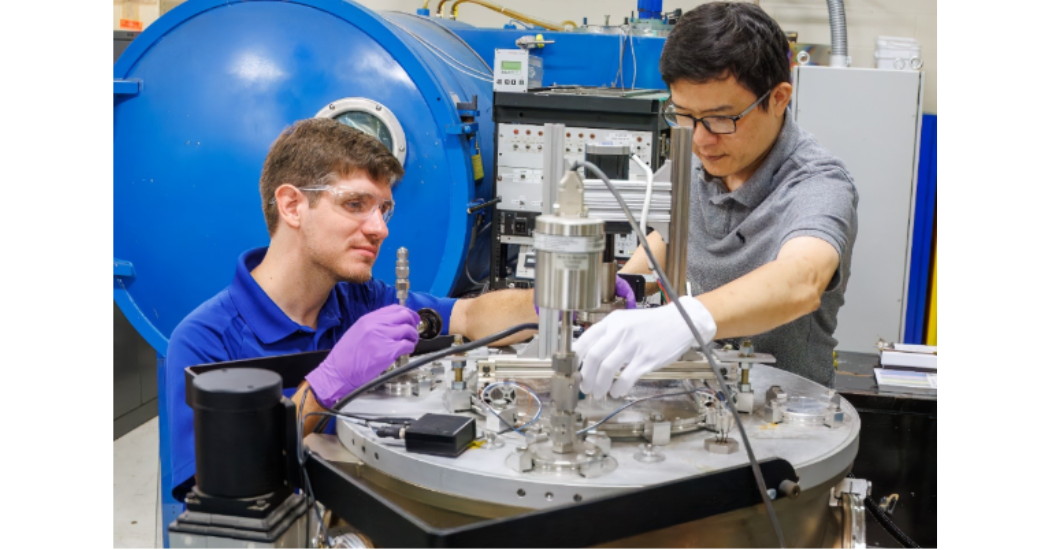
Caption: Southwest Research Institute and Southern Methodist University are collaborating to advance solid-state battery technology to improve stability and reliability. SwRI Senior Research Engineer Dr. John Hemmerling and Staff Scientist Dr. Jianliang Lin are using a deposition chamber to engineer ultra-thin films to reduce degradation and resistance at the anode-electrolyte interface of a solid-state battery.