Author: Stan Riddle, VibrAlign
“Should I mount the alignment tool on the hub or the shaft?” This question is asked frequently in our classes. In many cases, the question is asked because of smaller machines, which often have very little exposed shafting due to the size of the hub.
My answer? If you are using a laser alignment tool, mount on the hub, or the shaft, or one on each – it doesn’t matter! Here’s why.
Laser alignment tools measure shaft rotational centers, not hubs or shafts. So the alignment measurement is the difference in the two shaft centerlines – one moveable, and one stationary.
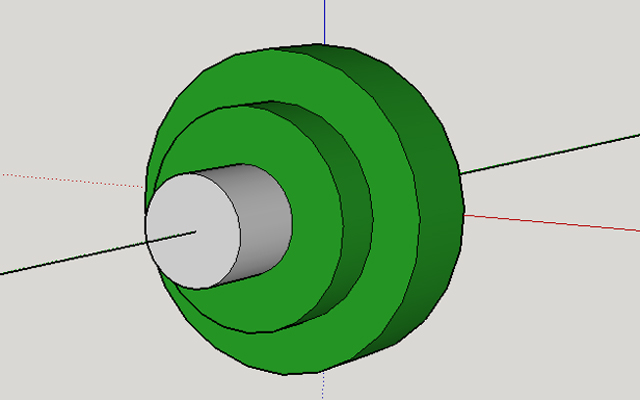
Think of it this way: if I mount the laser alignment tool onto the shaft, rotating the shaft would cause the laser to “draw” a small circle. If I mount the laser to the hub shoulder, it would “draw” a bigger circle. And if I mounted it on top of the hub itself, it would “draw” an even bigger circle. BUT, the centers of all three circles would be in the same place – the center of shaft rotation.
But what if the OD of the hub is tapered? The tool will still measure the difference in the centers of rotation of the two shafts, because rotating the tool around the hub, even a tapered one, will “draw” a circle.
So it really doesn’t matter if you mount on the shaft, the hub shoulder, or the top of the hub, as long as the two lasers “see” each other.