Why ePTFE Gasket-Tape and Joint Sealant Matters
Expanded polytetrafluoroethylene (ePTFE) gasket-tape and joint sealants are highly adaptable sealing materials used across numerous industrial sectors. Selecting the right type, mono-axial or multi-directional, is essential, as each offers distinct performance characteristics. The correct choice improves sealing reliability, reduces maintenance costs, and enhances equipment longevity.
So what? Choosing the wrong sealing solution can lead to premature failure, unplanned downtime, and avoidable maintenance costs, making informed selection a direct contributor to process safety and long-term operational performance.
What is ePTFE Tape and Joint Sealant?
Teadit ePTFE gasket-tapes and Joint Sealants are made from 100% virgin PTFE expanded in one or two directions. Key performance benefits include:
- Outstanding chemical resistance for aggressive or corrosive media.
- Low friction to reduce wear in static joints on rotating equipment (e.g., pump housings).
- Non-reactive and virtually chemically inert, ideal for sensitive environments like food processing and pharmaceuticals.
- Conformability, allowing sealing of irregular, narrow, or uneven surfaces.
- Easy installation, even around shafts or stems, without full equipment disassembly.
Available in a range of widths and spool lengths, they are an efficient alternative to cut gaskets, especially when handling variable geometries or urgent repairs.
Types of ePTFE Gasket-Tapes and Joint Sealants
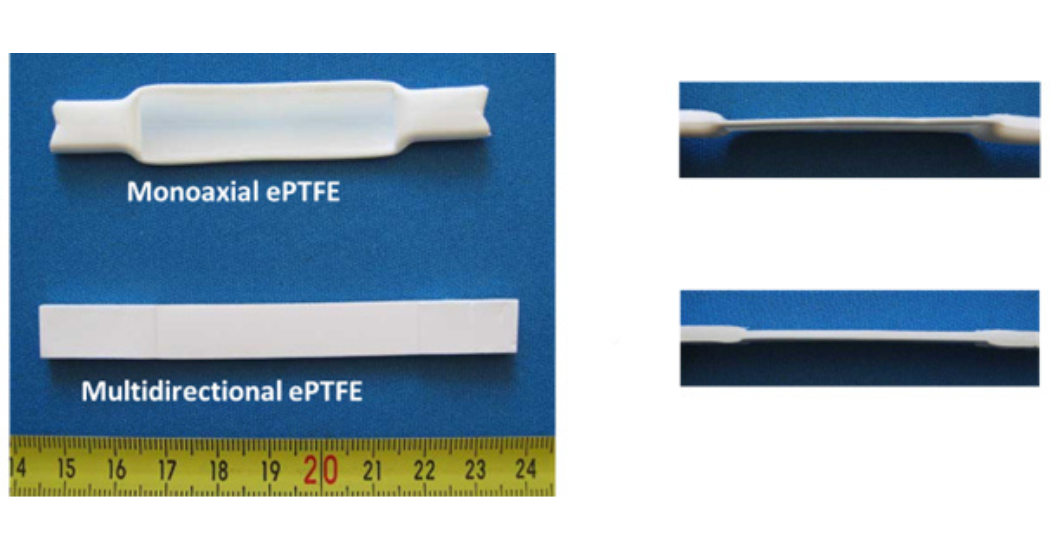
1. Mono-Axial ePTFE Joint Sealant
Example: Teadit 24B
- Expanded in one direction, making it highly flexible and extremely conformable.
- During compression, the tape spreads laterally by 200–300%, so sizing must account for this expansion.
- Ideal when ease of installation and adaptability are essential.
- Sometimes it is also called mono-axial gasket tape.
2. Multi-Directional ePTFE Tape
Example: Teadit 25BI
- Expanded in two directions for superior dimensional stability.
- High tensile strength in both longitudinal and cross directions ensures minimal width change under compression.
- Excellent solution for glass-lined equipment or warped surfaces where shimming is required.
- Offers high creep resistance at elevated temperatures.
Customization & Versatility
ePTFE tape and joint sealant reduces the need for large gasket inventories. A single roll can fit multiple diameters and complex flange shapes. In dynamic systems, such as pumps where internal components complicate gasket installation, they can be applied without dismantling shafts or stems, reducing downtime and simplifying maintenance.
Installation Essentials
Joint Sealant
- Ensure surfaces are clean; bolts/nuts well-greased.
- Apply tape inside the bolt circle, starting at a bolt hole.
- Overlap ends either crossed (≈20 mm) or skived and straight.
- Torque bolts in a star pattern in three stages ( 30%, 60%, and 100% torque load), then finish with a 100% torque circular pass.
- Use the next larger tape size for damaged or uneven surfaces.
- Two tape layers may be used for difficult sealing conditions.
- For thin or stress-sensitive flanges, apply tape inside and outside the bolt circle in order to prevent flange damage.
Multi-Directional Gasket Tape
- Clean sealing areas; grease bolts and nuts.
- Skive the beginning of the tape.
- Apply starting at a bolt hole, removing backing paper as you go.
- Overlap skived ends carefully to avoid leakage.
- For thin or stress-sensitive flanges, apply tape inside and outside the bolt circle in order to prevent flange damage.
- Torque bolts in a star pattern in three stages ( 30%, 60% and 100% torque load), then finish with a 100% torque circular pass.
- Two layers can be used for challenging conditions.
Key Takeaways
- Joint Sealant is the go-to for flexibility, simplicity, and maximum conformability.
- Multi-directional tape offers strength, dimensional stability, and superior performance on warped or sensitive surfaces.
ePTFE gasket-tape and joint sealant remains as invaluable sealing options, especially for custom dimensions, emergency repairs, or complex flange configurations. Its use helps engineers improve safety, efficiency, and operational reliability. It is always best to evaluate your sealing applications and maintenance challenges, then select the style that aligns with your operational needs.
To learn more about which ePTFE is right for your application, read the full article!