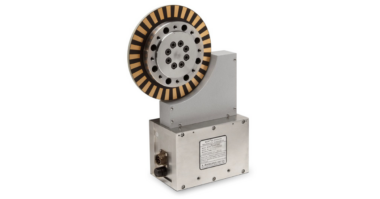
It is not possible to perfectly balance a rotating device. Thus, when a torquemeter, or any real rotating body, is operated at relatively low speeds its’ imperfect balance results in its’ center of mass following a small circular path. This situation will hold true as the rotational speed is increased until the first shaft critical is reached. At critical speed, large shaft deflections and excessive vibrations will occur. If the speed is increased, these vibrations will subside until a second shaft critical is reached when the symptoms will reappear. If operation is required at a critical speed, component life will be reduced and measurement accuracy degraded.
It is virtually impossible to encounter a critical speed when a Himmelstein MCRT® torquemeter is operated anywhere within its published speed rating. However, when high-speed versions of these torquemeters are supplied -usually including strengthened rotor assemblies, modified bearings and provision for external lubrication – it is conceivable that a critical speed will be encountered within the operating range.
This document has been prepared to assist you in evaluating the probability of such an occurrence. It also provides guidance concerning torquemeter mounting and coupling selection that allows you to increase the critical speed of a shaft system.
The critical speed of a shaft system including a torquemeter is related to torquemeter shaft design, bearing placement, torquemeter mounting, coupling characteristics and the interaction between the rest of the shaft system and the torquemeter. For applications where precise critical speed computations are vital, consultation with the factory is necessary. However, the following equations will allow approximate calculations.
FLOATING SHAFT TORQUEMETER MOUNTING
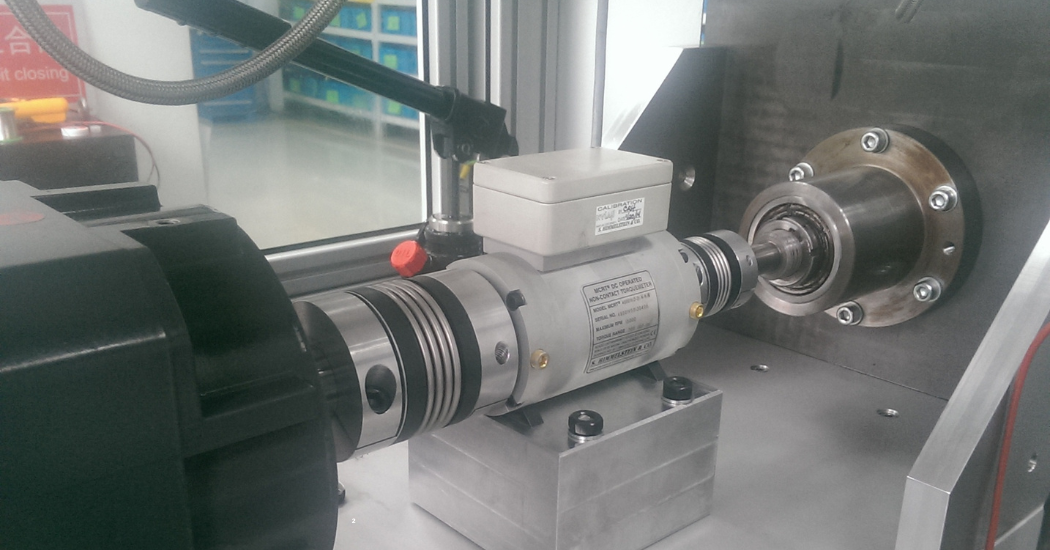
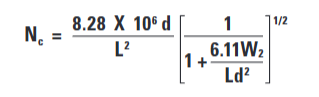
When the torquemeter is mounted as a floating shaft (see Fig. 1), the critical speed of the torquemeter only may be approximated by:
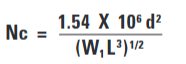
Where: Nc = Critical Speed (RPM)
d = Shaft Diameter (inches)
W1 = Weight of torquemeter (pounds)
L = Overall length of torquemeter shaft (inches)
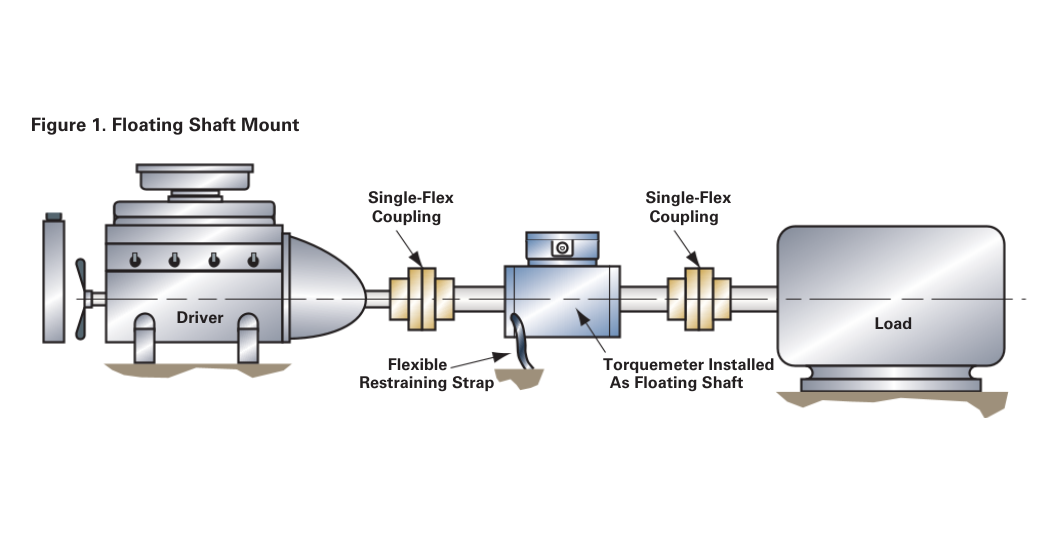 In this arrangement, the total weight of the torquemeter and the flexible couplings is supported by the input and output shaft system. As a result, the critical speed of the complete shaft system will probably be less than that given by the formula. Divide the calculated result by two (2) to obtain a conservative value.
FOOT-MOUNTED TORQUEMETER
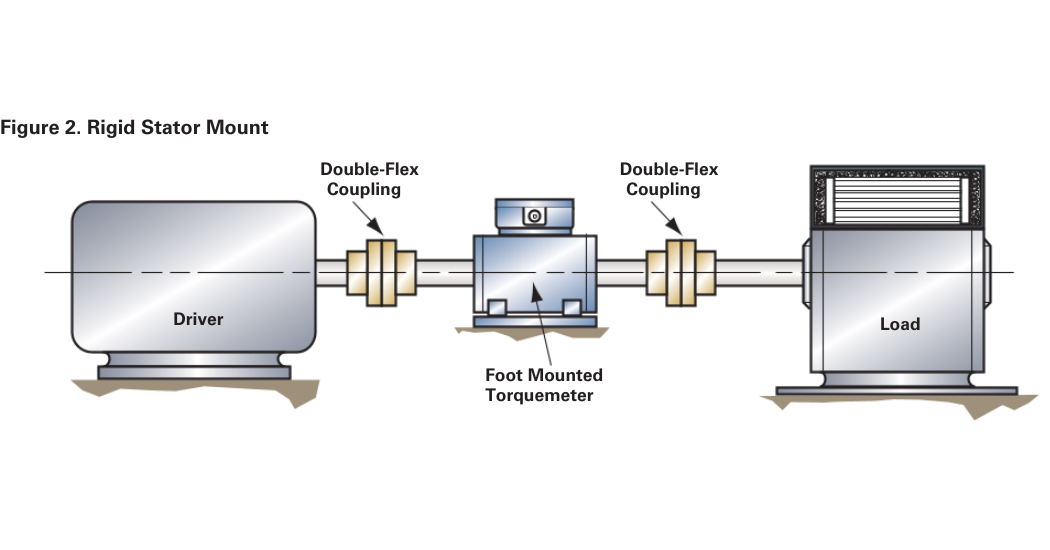
With a foot-mounted torquemeter (see Fig. 2), the critical speed of the torquemeter may be approximated by:
Where: Nc = Critical Speed (RPM)
d = Shaft Diameter (inches)
L = Overall length of torquemeter shaft (inches)
W2 = Weight of one complete coupling (pounds)
Because the double flex couplings tend to isolate the torquemeter from the rest of the shaft system, this
approximation is relatively accurate.
 OTHER CONSIDERATIONS
When operating at high shaft speeds, adequate bearing lubrication must be provided – in most cases external lubrication may have to be furnished. Too little lubrication can result in premature bearing failure.
Too much lubrication causes excessive viscous losses. Such losses will result in bearing heating and can cause torque measurement errors – the torquemeter reads the running torque of the load-side bearing. The shaft system, including Flexible Couplings, must be balanced for high speed operation.