SEEPEX’s hybrid approach to application engineering blends tribal knowledge with automation, digital tools, and modern customer expectations.
Progressive cavity pumping has always been a field where nuance matters. From sludge to slurry to shear-sensitive liquids, the details behind every application can dramatically change the out-come. It’s also a domain where much of the knowledge has historically lived not in software, manuals, or spec sheets—but inside the heads of seasoned application engineers who spent decades solving complex customer problems.
But as the pumping industry undergoes a generational shift, an other transformation is unfolding in parallel: pumping is going digital. Automation, connected services, cloud-based tools, and sizing programs now give engineers a different kind of insight— one based on data streams, simulations, and predictive analytics rather than intuition alone.
On the surface, these two forces—tribal knowledge and digital fluency—appear worlds apart. Yet at SEEPEX, the intersection between generations has become a competitive advantage rather than a liability.
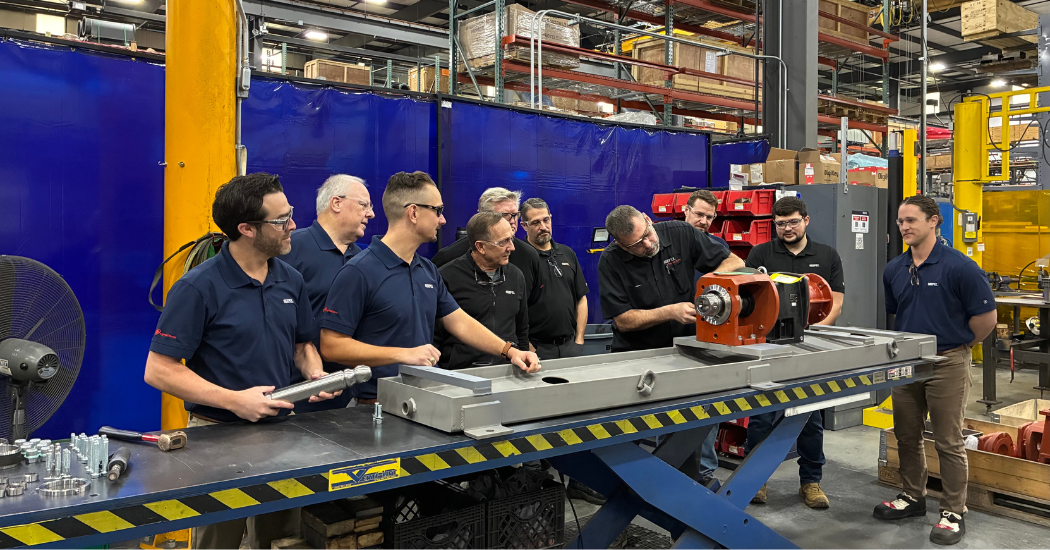
By intentionally pairing veteran application engineers with Gen-X and younger professionals, the company has created a hybrid application model that treats pumping as a team sport rather than a solo act.
The result is a new approach to problem-solving that draws power from both the analog past and the digital future.
The Stakes: A Generational Transition with No Playbook
Across the pumping industry, experienced professionals are retiring in waves. Their departure represents not just a headcount reduction but a potential knowledge vacuum. Many worked through the era before computers, CAD, or automation—and learned through decades of installation challenges, customer failures, design revisions, and hands-on troubleshooting. That kind of wisdom isn’t something that can be skimmed from a datasheet.
Doug Smith, a Senior Application Engineer who has spent four decades in the progressive cavity pump sector, embodies that legacy. “For 44 years, I’ve been processing orders on paper and have evolved from designing projects on drafting boards to CAD systems,” he recalls. “Seeing the cross generation here at SEEPEX, we are fortunate enough to have young and old team members to counterbalance old proven systems with new age systems.”
Smith plans to retire at the end of 2026, which adds urgency to the task. As he put it: “I’m retiring in less than a year, so it’s important for them to have as much knowledge as possible to succeed in taking the reins and moving forward.”
The knowledge transfer imperative is not isolated to SEEPEX. Trade associations and pump OEMs across the sector have been sounding alarms about the workforce gap for more than a decade. But while many lament the challenge, fewer have developed a structured solution for bridging it.
 Meet the Two Generations: The Veteran and the Next Wave
If Smith represents the historical mind of progressive cavity pump application, then his colleague Brian Wohlfarth, Inside Sales & Application Engineer, provides the counterweight. With six years at SEEPEX and a background in centrifugal pumps, Wohlfarth entered the industry at a moment of rapid digital acceleration.
“I just want to soak up as much knowledge as possible in a short amount of time,” he says. “Across the industry the experienced people are on their way out soon. We just want to understand what knowledge is vital, soak it in, and then keep it with us when they leave.”
For Wohlfarth, digital transformation is not a disruption—it’s the default. Where Smith started with drafting boards and water curves, Wohlfarth inherited software, databases, and cloud-ready sizing tools. Even historical archives are now being digitized.
“When I first switched from working with centrifugal pumps to progressive cavity pumps, we were in the transition between using paper pump curves and switching to digital,” he explains. “We now must locate all those old paper files and upload them into our system to build an accurate history.”
This generational juxtaposition creates friction at times—but it also creates opportunity.
The Tribal Knowledge Dilemma
Smith profoundly underscores the hidden depth of application expertise.
“When you have 44 years of experience at anything, you don’t even know what you know.”
This is precisely the challenge. Experts in any field eventually reach a point where their mental models shift from explicit (things they can explain) to tacit (things they simply do). In progressive cavity pumping—known for its sensitivity to viscosity, solids, elastomers, and operating conditions—tacit knowledge often determines success more than raw technical data.
Smith summarizes the three most important lessons he hopes to pass on.
“Don’t make assumptions. Understand what the customer wants. Be thorough with the details.”
Those three principles appear simple, but they underpin decades of complex decision-making. From specification review to installation-site evaluation, minor oversights can become costly failures.
Wohlfarth, for his part, recognizes the clock is ticking: “The question is, ‘How do we download all the experience that’s in the brains of the experienced engineers like Doug?’ We can only absorb so much in 11 months before he retires.”
His metaphor lands with force—because the industry has no “download button” for tribal knowledge.
Digital Fluency Joins the Lineup
Digital transformation has changed the way SEEPEX approaches this challenge. The company’s portfolio of digital solutions—from monitoring and IoT platforms to optimization tools and connected services—has rewritten the role of the application engineer.
Solutions like SEEPEX Connected Services, SCT Smart Conveying Technology, and predictive maintenance platforms have shifted attention from purely mechanical sizing to lifecycle performance, uptime, and OPEX reduction.
Wohlfarth sees this shift as an enabler, not a replacement. “We are trying to push out a quoting system that our channel partners can use to alleviate some of the tedious work,” he said. “Making that process easier opens time for our application engineers to work on more complicated scenarios.”
Smith admits it wasn’t always easy to embrace new technology. “I’m not much of an electronic guru,” he says. “The only computer we had back in the day was a TI-85 calculator.”
But once the tools proved value, his perspective changed. “Once you get the hang of doing it that way, you think, ‘Wow! This is great!’ I have to admit that this does make things easier, and in many cases, more accurate.”
The shift from skepticism to advocacy is emblematic of the collaboration SEEPEX now promotes.
Pumping as a Team Sport
Working as a team is critical to the SEEPEX approach.
“It’s not about who knows more than the other person,” Smith explains. “It’s about how can we attack this problem and find a solution that works for the customer.”
Wohlfarth notes the cultural importance of that dynamic: “We look up to them so much,” he says. “But we must not be afraid to go to people like Doug and say ‘Hey, these paper pump curves are not needed anymore. We have new resources that are better.’ I just remind myself that we are all on the same team.”
This mutual respect is the crucial differentiator. In many organizations, generational transitions fail not because of competence gaps, but because either:
- the veterans hesitate to share, or
- the younger talent hesitates to challenge.
SEEPEX has created an environment where neither happens. Veterans are encouraged to mentor, and the next generation is encouraged to question.
“It takes a good mix and balance,” Smith says. “We need this next generation as much as they need us.”
Looking Ahead: AI, Automation, and the Future Workforce
The next evolution, both men agree, will involve artificial intelligence. Smith imagines a future where a lifetime of troubleshooting—solutions, failures, experiments—can be stored and retrieved instantly.
“You can take a lot of past experiences, opportunities, successes, and failures and put that information in a database and allows the younger generation to be able to dig that information out from it,” he says. “This next generation could have all that experience and knowledge at their fingertips.”
Wohlfarth takes the idea one step further, joking that someone should build “DougGPT” to capture Smith’s 44 years of experience—illustrating how young engineers think about knowledge retention.
The balance between AI and application engineering rigor is delicate. As Wohlfarth cautions, “The work we do is very critical so until it’s all fine-tuned for our industry, we still need to be diligent and make sure we have everything exactly right.”
If the next decade is shaped by AI, cloud platforms, and digital twins, it may also be characterized by even more dramatic work-force turnover. “The entire knowledge base will be retired within five years,” Wohlfarth predicts. “Our team could get really young, really fast and it could become an issue.”
The implication is clear: digital tools are not optional—they are the scaffolding that will support future application engineering teams.
Two Generations, One Playbook
The SEEPEX approach suggests that no single generation is equipped to handle the future of pumping alone. Veteran engineers provide the historical decision models that help decode complicated applications. Younger engineers bring the software fluency and automation instincts that modern customers now expect. Digital tools provide a shared operational language that reduces friction and improves transfer of knowledge.
As Smith puts it: “It’s all about acknowledging everyone’s skills, finding a balance, and putting in the right lineup.”
That mirrors the needs of the broader industry. The future of pumping will belong not to the most experienced or the most digital, but to the organizations that learn to harness both. Experience may power the sector today, and the next generation may drive its evolution—but only together can they keep progressive cavity pumping moving forward.
Building the Future Workforce
As experienced professionals across the pump and process industries retire, SEEPEX is taking a proactive approach to work-force evolution. Beyond technical innovation, the company is investing in creative, people-focused HR strategies to attract and inspire the next generation of talent.
Through social media, in-person events, training programs, and hands-on exposure to application engineering, SEEPEX is helping reposition the pump industry as a place to build a meaningful, long-term career while preserving the deep expertise that continues to drive its success.
 About the Author: Michelle Segrest is President of Navigate Content, Inc. She has been reporting on the pump industry since 2008. She is the author of a series of books on Modern Manufacturing best practices.