Fire hydrants stand as an essential component of urban safety systems. Often unnoticed until an emergency arises, their reliable functionality is vital for firefighters to protect lives and properties. Ensuring their longevity, water operators must adhere to precise installation standards, conduct consistent maintenance, and follow thorough repair protocols.
Ensure Proper Installation by Allotting Adequate Time
Hydrants should be properly buried to the marked “BURY” line on the lower barrel—just below where the lower barrel connects to the upper barrel. Proper bury depth is important because, if struck, the hydrant is more likely to break safely. Extensions or risers are available to ensure proper bury depth. Extension kits can run in six-inch increments, from 6 inches and up.
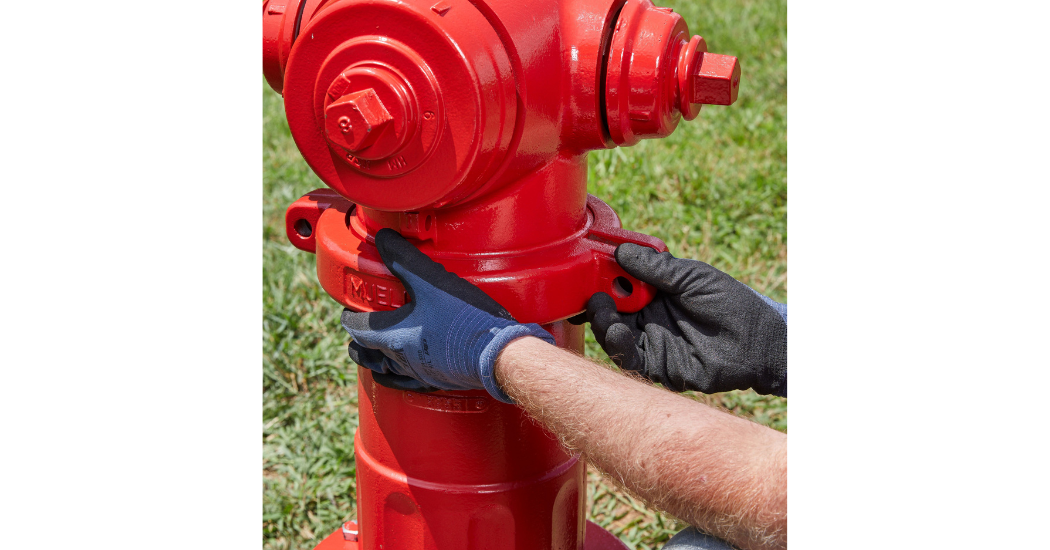
Traffic flange and break coupling placement is very important, especially when using an extension. The traffic flange protects vehicle operators in the event of collision with a hydrant, as the hydrant will break and fall at the flange location, rather than staying upright and increasing the force of impact.
Proactive Upkeep
Most fire hydrants are made with iron, steel, brass, and stainless-steel parts. With proper care, a fire hydrant can last a long time. However, because hydrants are made with so much brass, especially the connections, proper tools are important to maintain their durability and longevity. Tools such as pipe wrenches inflict damage that hydrant-specific tools will not.
Hydrants should be flushed at least twice each year and should be fully open when flushed. The main valve is made of rubber and seals against a brass seat. Partially open hydrants will pull the valve off the seat just far enough that rocks, stones, and other debris can be caught in the opening, leading to a loose or damaged seal and a leaking fire hydrant. This can result in the main valve having to be replaced or repaired. Over-opening and over-closing should also be avoided, as it can damage the stem.
Most hydrant bonnets are labeled with the direction of operating nut opening, if not you will need to look at the operator manual. Note that turning the operating nut does not turn the stem inside; instead, the threads in the operating nut push the stem straight down as the operating nut turns, pushing the main valve farther into the water way.
The act of flushing a hydrant will also maintain stem and operating mechanism lubrication. As the operating nut moves apart from the stem, a hole in the operating nut will be exposed, allowing lubrication to enter a cavity inside the operating nut. When the hydrant is closed again, the hole in the operating nut is also sealed off, pushing lubrication from inside of the cavity out of the two top holes of the operating nut. The lubrication used on the fire hydrant should be a food grade oil or grease. Once the hydrant is fully closed after flushing, reverse the direction to release tension off the stem assembly.
Newer hydrants come often come with an identification tag to assist operators and workers to identify the hydrant model and its specific technology, including the model number; steamer, hose, shoe, and connection information; bury depth; year; the paint code; and more. The tag may also provide access to a troubleshooting guide which can be very helpful in the field.
 The Most Common Repair Job – Replacing a Damaged Valve
In cases where a valve must be replaced due to debris damage, a specific series of steps should be followed to ensure a safe, proper replacement. It is also recommended to place safety chains on the hydrant to ensure the caps do not cause injury due to accumulated pressure. The main valve opening size is usually stamped on the upper barrel. The two most common sizes are 4-1/2” and 5-1/4”.
With the correct valve size, replacement can be done in the following steps:
- Shut off the water to the fire hydrant.
- Open the fire hydrant main valve to confirm the water is shut off.
- Depressurize the hydrant by loosening a cap.
- Remove the nuts and bolts on the bonnet and remove the hold-down nut.
- After removing the hold-down nut, check the integrity of the O-ring seals.
- Open the operating nut, which will raise the thrust collar. Some hydrants may have a stop nut
that will need to be removed. - Remove the bonnet. When removing the bonnet take care not to damage any O-ring seals that
may be present. - Using a seat wrench, catch the tabs on the main valve assembly and rotate. To break the main
valve assembly free may require significant pressure, so specialty tools can help. Some wrenches
allow hookup to a vehicle for more torque. - Once loosened, pull the stem from the top of the hydrant, which will lift and remove the main
valve assembly. - Remove the valve plate nut (if present) and any gaskets that protect the stem threads from
washer to access the lower valve plate. (In some hydrant models the valve plate and plate nut
are a single piece) - Remove the lower valve plate to expose the valve.
- Replace the valve and seat ring O-rings. There are typically two seat ring O-rings: upper and
lower. - Replace lower valve plate, gaskets, and valve nut. Tighten to recommended torque.
- Lower the assembly back down slowly into the hydrant. Once lowered, to align the threads with
the floating drain ring, turn the stem backward two full turns. A click will sound when the
threads are lined up.
Documentation of Hydrant Servicing
This is very important for a municipality to know which hydrants have been repaired/inspected or need to be repaired/inspected. This is an important part of any maintenance and inspection program and benefits from more detail than less. It is also very important that any issue discovered during an inspection is repaired in a timely fashion. Any fire hydrant that is deemed inoperable should be black bagged or tagged to prevent accidental use and replaced or repaired as soon as possible.
A quality hydrant can be operational for many years past its warranty providing it is part of a regular maintenance and repair program. Having the right tools and parts on hand will help operators to ensure the program is effective. Some manufacturers offer training and support, along with how to videos, these resources can be very helpful for new employees.