When the 2026 FIFA World Cup launches across 11 American host cities, worldwide attention will be on scores, teams, and game-winning plays. But a more fundamental question flies under the radar: can U.S. water infrastructure handle the pressure of a global stage?
With a record 48 teams and millions of expected visitors, this tournament is being compared to hosting seven Super Bowls every day for a month. However, unlike a Super Bowl, the World Cup will take place in stadiums across the country. For U.S. water systems, this is a nationwide stress test, playing out in real time before an international audience.
Eight out of eleven host cities face water stress
The numbers tell a sobering story. According to Pitches in Peril, the first global climate risk report for soccer, eight of the eleven U.S. World Cup venues face water stress severe enough to pose a risk of event disruption—meaning irrigation water availability is increasingly uncertain. In practical terms, that raises the risks of usage restrictions, higher water costs, or operational strain during the competition itself.
MetLife Stadium, the venue for New York and New Jersey, received the highest water stress score of all; its low elevation leaves it acutely vulnerable to storm surges and saltwater intrusion–threats that can directly affect drinking water quality.
The good news is many stadiums are being proactive, not reactive, to water management challenges.
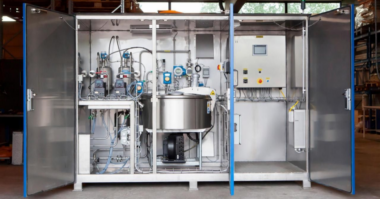
Across the country, major venues have invested in on-site water reuse systems designed to recycle wastewater and capture rainwater for non-potable applications like toilet flushing, irrigation, and pressure washing. This reduces their draw on municipal water supply and minimizes, or even outright eliminates, their discharges to municipal wastewater systems.
Gillette Stadium operates the largest water reuse facility in Massachusetts. Mercedes-Benz Stadium in Atlanta uses a 680,000-gallon rainwater cistern that recycles stormwater for landscape and urban garden irrigation; combined with the stadium’s water-efficient fixtures, potable water use is cut nearly in half. In addition to on-site production, stadiums are also importing recycled water. Levi’s Stadium in the San Francisco Bay Area sources roughly 85% of its water from municipally recycled supplies, provided by the Santa Clara Valley Water District.
These are meaningful investments in water resilience, though they’re the exception and not the rule. As extremely resource-intensive commercial facilities, often supported by both private and public revenue streams, sports stadiums have a far greater runway to finance sustainability than most utilities.
Modern stadiums. Aging pipes.
While stadiums demonstrate water stewardship and continue to modernize, the municipal water systems that serve them and their surrounding communities commonly tell a different story.
In Philadelphia, roughly 20 miles of water mains predate the Civil War. In the U.S., a water main break occurs approximately every two minutes, and a sizable portion of the nationwide network is operating beyond its intended lifespan. The World Cup is anticipated to exacerbate these existing vulnerabilities. Some host cities are accelerating long-overdue upgrades. Arlington, Texas, invested US$44 million in water treatment upgrades in 2025 to boost capacity ahead of AT&T Stadium matches, which is US$35 million more than its combined 2026 and 2027 budgets. Nearby Fort Worth is racing to replace aging cast iron transmission mains that accounted for over 85% of water main breaks in the city’s distribution system in 2025.
These efforts matter. But they also underscore a larger reality:
The World Cup can accelerate infrastructure investment, but it can’t make up for decades of deferred maintenance.
A global event shouldn’t be what finally moves critical water upgrades forward. Yet, in many cases, it is.
The hidden water conversation: what fans drink from
Another shift is happening inside stadiums: venues are increasingly moving away from single-use plastic water bottles. NRG Stadium in Houston and SoFi Stadium in Los Angeles, for example, now allow fans to bring empty reusable containers and access free refill stations throughout their respective facilities. The environmental logic is sound. So is the public health argument: one academic study found that the average liter of bottled water contains 59 times the plastic particles found in a liter of tap water.
But the deeper issue is trust. More than half of Americans believe it’s unsafe to drink tap water at home: a perception gap that costs utilities enormously in consumer engagement. Stadiums, with their high visibility and captive audiences, are uniquely positioned to change that. Every hydration station is also a referendum on the safety and quality of America’s water supply, and every refill is a small, visible vote of confidence.
Every match is a halftime flush problem
One of the least visible but most intense stressors on water systems is also the most predictable: halftime. When thousands of fans simultaneously head to the restroom during a 15-minute break, supply usage spikes sharply. While stadiums are designed to handle this surge, the World Cup’s recurring, massive water demands are anticipated to place significant strain on public distribution networks. Outside of gameplay, the influx of visitors means more water is being drawn for everyday use, including for showers, sinks, and cooking.
Local plumbing companies are already warning homeowners in host cities to expect weaker water pressure during matches and to consider backflow prevention measures for irrigation systems and boilers.
The Bottom Line
While improvements are underway, U.S. water infrastructure could be stressed this summer during the 2026 World Cup, due to years of underinvestment. As we enter a future in which climate patterns are uncertain and aging infrastructure becomes more prevalent, the health of the U.S. water sector is a critical concern.
Water isn’t an amenity. It’s the foundation. And the real question is not whether the system will hold for one tournament—but whether cities will act before the next stress test arrives.