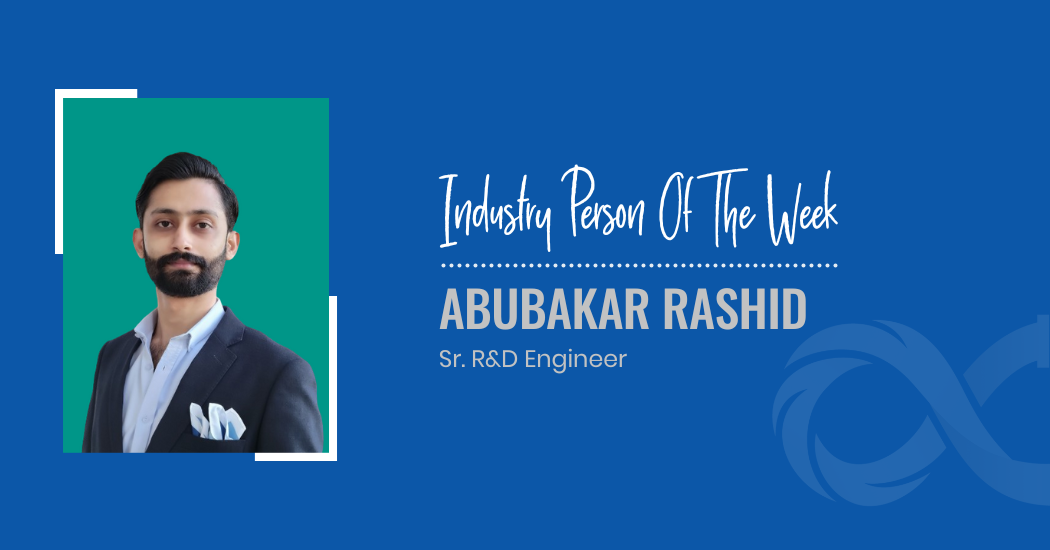
Meet our Industry Person of the Week, Abubakar Rashid, Sr. R&D Engineer – New Product Development Turbomachinery & Systems.
Q: How did you get started working in your field?
Abubakar: Looking back, I think I was destined for the world of rotating equipment long before I knew what a pump curve was. As a kid, I was the “builder child”, the one who took apart toys, made DIY contraptions, and occasionally put them back together correctly. I loved anything that moved or spun, so Mechanical Engineering felt like a natural extension of who I already was.
My professional journey began in a large petrochemical complex, where I spent significant time around
turbomachinery and pumps. Starting on the maintenance side gave me a strong foundation in operations, preventive and predictive maintenance, diagnostics, and root-cause analysis. Those early years taught me that machines always tell a story, you just need to know how to listen.
As my curiosity grew, I wanted to understand the other side of the equation: the design intent, the engineering behind the machines, and the thought process of the OEMs. That led me to pursue my MS in Mechanical Engineering at Texas A&M University, with a research focus on the Performance & Reliability of Turbomachinery. After that, I joined Flowserve Corporation, where I’ve held multiple roles and now work as a Senior R&D Engineer in New Product Development. It still feels like the dream version of my childhood hobbies just with bigger & louder toys.
Q: What advice would you give to someone considering this line of work or new to the field?
Abubakar: My biggest piece of advice is to cultivate an inquisitive mind. Curiosity is one of the most valuable tools an engineer can have. In mentoring young engineers, I often emphasize that attitude comes before technical skill. Skills can be taught, but curiosity, ownership, and humility shape long-term success.
Also, never hesitate to ask questions, there truly are no “dumb” questions in this field. Sometimes the simplest question leads to the most important insight. A moment of embarrassment is a fair price for a lifetime of clarity.
I also encourage new engineers to develop a strong understanding of what already exists. Whether you want a career in R&D, operations, or design engineering, having a good grasp of current technologies, product history, and established solutions provides the foundation for meaningful innovation. You don’t want to unknowingly reinvent the impeller from 1983.
Q: Can you talk about a project you recently worked on?
Abubakar: One of the most rewarding projects I recently worked on focused on improving the First Pass Yield (FPY) of our centrifugal pump performance testing process. We were consistently seeing lower-than-expected FPY results, which naturally created rework, delays, and inefficiencies.
Instead of treating it as a simple procedural issue, we approached it as a broader engineering challenge,
looking at how our pumps behaved under different test conditions, how different operations and setup practices influenced outcomes, and how test execution varied across platforms. We collaborated closely across engineering, operations, and quality teams to refine our processes and bring more consistency into the testing environment.
We also incorporated an analytical layer to help confirm patterns and validate improvements, and to direct our efforts with a data-driven bias for the project that remained strong engineering fundamentals and practical execution. The improvements were substantial; we successfully achieved the goal, scoring around 12% increase in FPY. Additionally, we saw higher consistency, reduced rework cycles, and a meaningful uplift in reducing inefficiencies around the process. The best part is that this initiative has now evolved into a global improvement program being adopted across multiple Flowserve sites, which is incredibly fulfilling to see.
Q: Anything else you would like to add?
Abubakar: I’d like to highlight the exciting role that artificial intelligence is beginning to play in our industry. While the pump and turbomachinery world hasn’t traditionally been at the forefront of digital transformation, I think that’s changing rapidly. With the right understanding of data and generative AI, we can unlock new opportunities in reliability, design, and performance optimization.
Conceptually, AI can support everything from predictive maintenance and automated test evaluation to digital twins and smarter diagnostics. The combination of engineering intuition with data-driven intelligence will define the next generation of innovation. And honestly, the idea of smarter pumps and rotating equipment feels like a natural evolution, one that I’m excited to be part of.
THANK YOU, ABUBAKAR! WE LOOK FORWARD TO KEEPING UP WITH YOU THROUGH THE #PUMPTALK COMMUNITY!