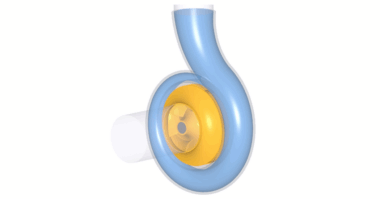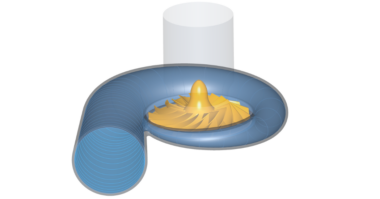
From a spark of inspiration in a Dresden library to cutting-edge design automation software used by global innovators, CFturbo is reshaping how engineers conceptualize, simulate, and optimize rotating equipment.
By Michelle Segrest
It started with a magazine cover.
In the fall of 1985, Ralph Peter Mueller, then a first-year engineering student in Dresden, Germany, found himself spellbound in a university library. The Mechanical Engineering journal from ASME featured a cover story titled “Visualizing Flow in the Space Shuttle Main Engine.” That single article sparked a lifelong fascination with fluid dynamics, turbomachinery, and simulation—and, eventually, led to the founding of one of the most forward-thinking companies in the field: CFturbo.
“I knew right then that my life would be about fluid flow, turbomachinery, and software,” Mueller recalls.
Today, as president of CFturbo, Inc., Mueller leads a company that is redefining how engineers and designers conceptualize rotating machinery—from pumps and compressors to fans, turbines, and more. What began as an engineer’s dream has grown into a globally respected software platform with customers across sectors including automotive, aerospace, energy, and high-performance motorsports.
From Vision to Virtual Prototyping
While Mueller’s journey included early career stints at General Motors and launching CFDnetwork, it wasn’t until the early 2000s that CFturbo truly began to take shape. In partnership with co-founder Gero Kreuzfeld, the idea was simple but revolutionary: develop a user-friendly yet powerful tool that could support both novice and expert users in designing turbomachinery systems.
“At the time, there were only a few conceptual design tools available—and they were deeply specialized,” Mueller explains. “We wanted to empower the ‘ordinary’ mechanical engineer tasked with designing rotating equipment, while still offering the depth needed by experts and researchers.”
The result was CFturbo: an intelligent 3D-CAD system that bridges the gap between accessibility and high-performance simulation. Officially launched in 2008 in Germany, with a U.S. subsidiary added in 2017, CFturbo has steadily grown its global footprint, which includes a loyal network of distributors and a steady stream of software innovation.
Designing with Intelligence and Intuition
One of CFturbo’s defining features is its ease of use. A turbomachinery design that might once have required complex hand calculations and multiple tools can now be generated with just a handful of input parameters—flow rate, pressure ratio, rotation speed, and fluid properties.
“The entire sequence of design steps is intuitive,” Mueller says. “From centrifugal rotors to vaned stators and volutes, our system can build detailed models with surprising speed.”
That speed doesn’t come at the cost of capability. CFturbo supports seamless export to third-party CFD and FEA platforms, allowing engineers to conduct simulation and optimization workflows without leaving their ecosystem of choice. Its GUI, praised by users for its clarity and efficiency, sets a high bar in an industry where usability is often an afterthought.
And with modules for axial, radial, and mixed-flow pumps, fans, compressors, turbines, and more, the software now covers nearly the full spectrum of rotating machinery applications.
 Beyond Software: Services that Solve Real Problems
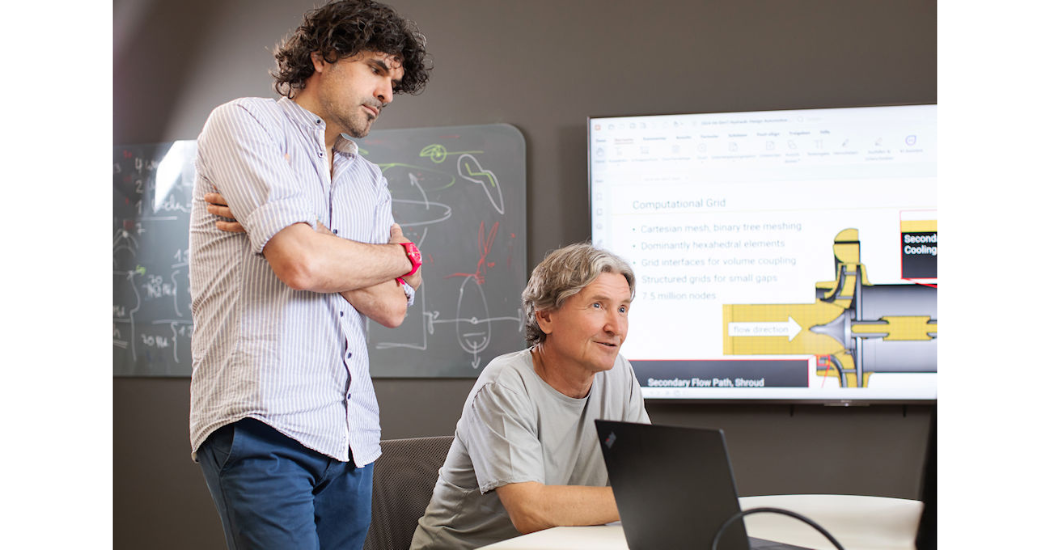
While CFturbo’s primary product is its design platform, the company also offers two tiers of engineering services: training and consulting. Training can be delivered on-site or online, while consulting projects often serve customers who prefer outsourced design and simulation workflows using CFturbo in combination with tools like Ansys, Star-CCM+, or Simerics MP/MP+.
One notable success story came from the motorsports division of a major German automotive manufacturer. Facing space constraints and tight deadlines, the client turned to CFturbo to design a dual-purpose pump for electric vehicle cooling—a water pump on one shaft end, an oil pump on the other. Compact, efficient, and delivered fast.
“The car won the race,” Mueller says.
Sustainability by Design
As global industries work to reduce carbon footprints and meet increasingly stringent environmental regulations, energy efficiency has become more than just a design preference—it’s a mandate.
Whether in HVAC systems, electric vehicle propulsion, renewable energy, or water infrastructure, turbomachinery lies at the heart of many energy-intensive processes. And CFturbo is enabling engineers to reimagine these systems with sustainability front and center.
“At its core, our software helps designers create machines that do more with less,” says Mueller. “Less energy, less material, less waste.”
CFturbo’s contribution to sustainability is both direct and systemic. By making it easier to model, simulate, and optimize rotating machinery, the platform supports the development of pumps, fans, turbines, and compressors that operate with higher hydraulic and thermodynamic efficiency. In practical terms, that can mean a lower specific energy consumption for a pump in a municipal water system, or improved airflow in a data center with reduced cooling loads.
The platform also facilitates rapid iteration, allowing users to explore alternative materials, geometries, or operating conditions early in the design process. This leads to more refined designs that not only perform better, but can also extend equipment life and reduce total lifecycle emissions.
“Our users are often under pressure to meet both performance and sustainability targets,” Mueller explains. “CFturbo gives them the tools to achieve both—without needing to choose one over the other.”
In this way, sustainability isn’t an afterthought or an add-on feature. It’s embedded in the workflow CFturbo promotes fast conceptual design, seamless simulation integration, and informed optimization. As the world transitions to a cleaner, more efficient energy future, tools like CFturbo will continue to play a quiet but essential role in that transformation.
 Looking Ahead: AI, Automation, and the Rise of CFturbo BLADERUNNER
For decades, turbomachinery design has been the domain of seasoned experts—engineers with deep theoretical knowledge and years of experience balancing performance, manufacturability, and cost.
But today, a new era is unfolding.
True to its legacy of innovation, CFturbo is pioneering tools that bring that same level of expertise within reach of a broader engineering community.
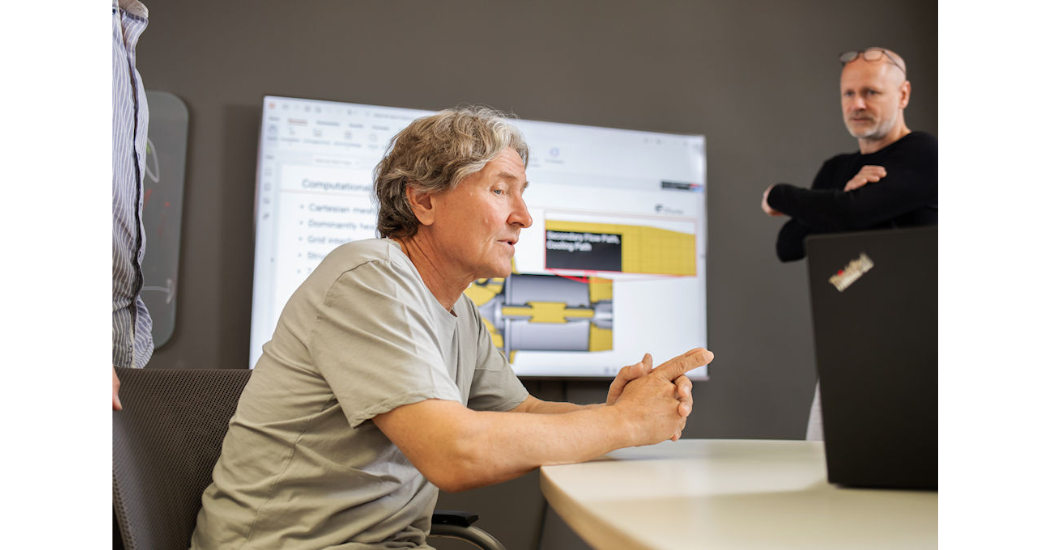
At the center of this transformation is CFturbo BLADERUNNER, a next-generation simulation manager that automates CFD workflows and enables rapid design exploration. Born from the need to accelerate and optimize rotating machinery development, CFturbo BLADERUNNER gives engineers the power to automatically simulate, evaluate, and iterate on a wide range of design parameters—without manually setting up each scenario.
“CFturbo BLADERUNNER allows users to run dozens or hundreds of design variations overnight,” Mueller explains. “It essentially functions like a digital assistant—handling repetitive simulation tasks so the engineer can focus on making better decisions.”
Built to work seamlessly with popular CFD solvers such as Ansys CFX, OpenFOAM, and Simerics MP/MP+, the platform manages geometry creation, mesh generation, boundary conditions, job submission, and post-processing in a unified interface. This level of automation opens the door to design-of-experiments (DOE), multi-objective optimization, and machine-learning-assisted design—workflows that were once reserved for elite simulation teams with substantial resources.
Even more exciting is CFturbo BLADERUNNER’s potential as a foundation for AI-driven turbomachinery development. With GPU acceleration, cloud compatibility, and modular integration, the tool is being positioned to leverage emerging trends like neural network-based surrogate modeling and automated response surface generation.
“GPU processors, machine learning, and AI are all reshaping what’s possible,” Mueller says. “We’re building tools that let users take advantage of these advances without needing a Ph.D. in computational science.”
In effect, CFturbo BLADERUNNER embodies CFturbo’s mission: to democratize sophisticated design tools and empower users at every level—from seasoned turbomachinery experts to agile R&D teams, and even university researchers. It’s more than a product; it’s a platform for accelerating innovation.
And with CFturbo’s commitment to biannual software updates, customer-responsive development, and a growing global presence, the company isn’t just keeping up with the evolution of CAE—it’s helping lead the charge.
 Engineering the Future of Flow
From a single moment of inspiration in a university library to the global stage of CAE innovation, CFturbo has carved a unique path in the world of turbomachinery design. What began as a mission to make conceptual design more intuitive has evolved into a comprehensive ecosystem—one that empowers engineers to create smarter, more efficient machines in less time and with greater confidence.
In an era where industries are under pressure to deliver cleaner energy, reduce emissions, and accelerate product development cycles, CFturbo’s impact is both timely and profound. Its software does more than just generate CAD models; it facilitates smarter decision-making, encourages experimentation, and lowers the barrier to entry for complex simulation work. Engineers no longer need to rely on legacy tools or wait weeks for iterative results. With CFturbo and CFturbo BLADERUNNER, innovation can happen on the fly—and at scale.
Equally important is the company’s commitment to sustainable engineering. By enabling energy-efficient designs, minimizing waste, and shortening development timelines, CFturbo is playing a quiet but essential role in the global transition toward decarbonized and resource-responsible industries.
As artificial intelligence, GPU-accelerated computing, and automated workflows become the new normal, CFturbo’s forward-looking platform positions it not only as a technology provider, but as a visionary partner for engineering teams seeking to stay ahead of the curve.
“We’re not just building tools,” Mueller says. “We’re shaping the way engineers think about turbomachinery—and giving them the power to turn bold ideas into reality.”
With its blend of technical rigor, elegant simplicity, and relentless innovation, CFturbo is engineering more than flow paths. It’s engineering the future of flow itself.
 Michelle Segrest is president of Navigate Content, Inc. She has been reporting on the industrial processing industries since 2008.